

3D rendering has transformed how developers sell off-plan properties in South Africa. By turning architectural plans into lifelike visuals, buyers can now visualise homes before construction begins. This approach not only builds trust but also speeds up sales, helping developers secure funding earlier. Here’s why 3D rendering is a must for pre-construction sales:
- Realistic Visuals: Buyers can see detailed interiors and exteriors, reducing uncertainty.
- Faster Sales Cycles: Developers can market projects within weeks of planning approval.
- Cost-Effective: Interior renders start at R4,500, while exteriors cost around R7,700.
- Buyer Engagement: Tools like animated tours and virtual staging create emotional connections.
- Local Appeal: Customised designs reflect South African styles and lighting conditions.
Why 3D Rendering Matters for Pre-Construction Sales in South Africa
Building Buyer Confidence with Realistic Visuals
For many South African buyers, technical drawings feel too abstract, making it challenging to imagine what their future home will actually look like. This poses a big challenge for developers who need to secure off-plan sales. Craig Mott, Western Cape Regional Sales and Commercial Manager at Rawson Property Group, highlights this issue:
"Marketing plays a crucial part in showcasing development property, securing buyer interest, and closing sales. When selling off-plan it’s important to use the right type of visual aids."
Photorealistic 3D renders address this challenge by offering buyers a clear and detailed view of what they’re purchasing. From kitchen finishes to bathroom fittings and lighting features, these visuals go beyond just the structure – they paint a picture of the lifestyle the property offers. Buyers are able to picture themselves in the space, creating an emotional connection that flat 2D plans can’t provide. This realistic representation reduces the uncertainty often associated with off-plan purchases, making buyers more confident about committing to properties that are yet to be built. This increased trust helps speed up the sales process.
Speeding Up Sales Cycles for New Developments
One of the biggest advantages of 3D rendering is that developers can begin marketing as soon as planning approval is secured – no need to wait months for a physical show house. Some South African developers have even managed to reserve 100% of units before construction started, thanks to high-quality CGI.
Creating renders for a single house type typically takes around two weeks, while large-scale developments can be completed within two months. This quick turnaround allows developers to secure reservations and attract investors much earlier. The faster sales cycle not only improves cash flow for construction financing but also boosts developer confidence. It’s a win-win for both developers and buyers, meeting the demand for efficiency in today’s property market.
Meeting South African Buyer Expectations
Today’s South African buyers expect professional visuals that provide a realistic and detailed preview of their potential investment. This trend has grown even stronger since the Covid-19 pandemic, as virtual walkthroughs and video presentations have become standard tools for buyers wanting a thorough understanding of their purchase.
Modern 3D rendering technology has advanced to the point where it produces incredibly lifelike imagery, meeting the high standards of South African buyers. These visuals are especially critical for attracting international investors who can’t visit the site in person. For developers targeting the luxury market, hyper-realistic visuals aren’t just a nice-to-have – they’re essential for staying competitive and closing deals in slow or crowded markets.
sbb-itb-f5a6292
Utilizing Real Estate Renders To Sell Developments
Core 3D Rendering Services for Development Marketing
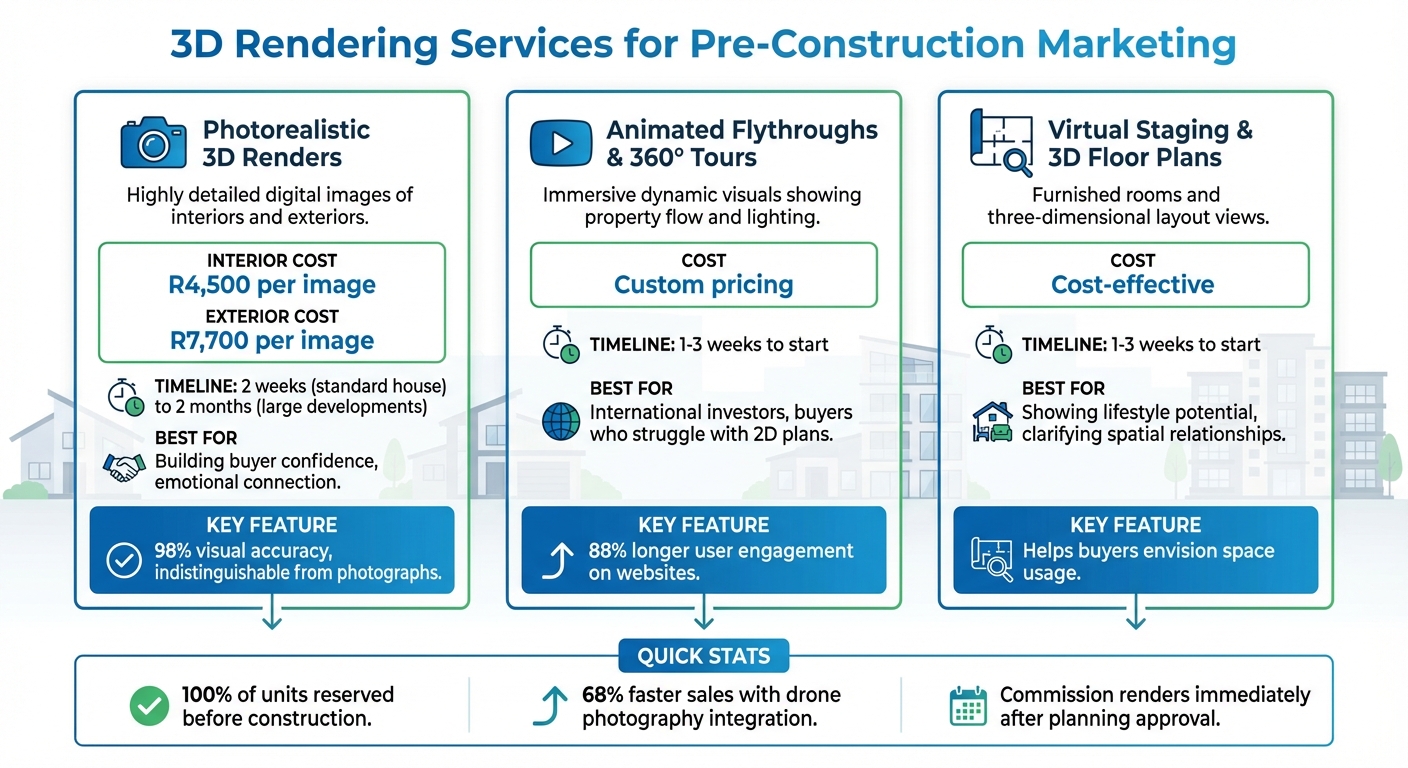
3D Rendering Services Comparison: Types, Costs and Timelines for South African Property Developers
When it comes to pre-construction marketing, engaging visuals are essential. The right 3D visualisation services can make all the difference, helping you align your marketing strategy with your goals. Each type of visual serves a unique purpose, so understanding their benefits will help you plan your budget and timeline wisely.
Photorealistic 3D Renders
Photorealistic 3D renders, often referred to as architectural visualisations or CGIs, are highly detailed digital images that showcase a property’s interior and exterior with stunning accuracy. These renders capture details like lighting, textures, and materials so precisely that they’re often indistinguishable from real photographs. They’re a cornerstone of pre-construction marketing because they turn technical architectural plans into visuals that buyers can easily grasp and connect with emotionally.
For pricing, interior renders generally cost around R4,500 per image, while exterior renders start at approximately R7,700 per image. The production timeline varies: a standard house takes about two weeks, while larger developments may take up to two months. To get the most out of your pre-construction sales period, it’s best to commission these renders as soon as your planning is approved and your .dwg files are ready.
The quality of these renders is critical. Hyper-realistic imagery can evoke stronger emotional responses from buyers compared to basic digital models. You can also tailor interior mood boards to reflect the preferences of your target audience, making the visuals even more compelling.
Animated Flythroughs and 360-Degree Tours
While static renders beautifully highlight individual parts of a property, animated flythroughs and 360-degree tours provide a more immersive experience. These dynamic visuals let buyers explore the flow of spaces, observe how natural light interacts with rooms throughout the day, and get a feel for the overall atmosphere of the property. This interactivity turns potential buyers into active participants, allowing them to explore every detail from their own devices and boosting engagement significantly.
This approach is particularly useful for international investors who can’t visit the site in person. It’s also a game-changer for local buyers who might struggle to interpret 2D floor plans, as it helps them understand the spatial relationships between rooms. Real-time environments add another layer of engagement, letting buyers preview custom finishes and interact with property features.
For an even greater impact, pair animations with interactive plot locators. These allow buyers to click on specific units for more details and include direct calls-to-action. To enhance location-based appeal, combine your 3D renderings with real aerial drone photography to place the development within its actual surroundings. Together, these tools provide a complete picture – showing both the intimate details of interiors and the broader neighbourhood context – making them an excellent addition to any marketing campaign.
Virtual Staging and 3D Floor Plans
Virtual staging uses 3D visualisation to transform empty spaces into fully furnished rooms that reflect the lifestyle of your target buyers. It helps buyers envision how they could use the space, answering practical questions and creating an emotional connection that can lead to reservations.
3D floor plans complement virtual staging by giving buyers a clear, three-dimensional view of the property’s layout, room sizes, and overall flow. Most people find technical drawings difficult to interpret, so these plans are invaluable. They can also double as CGI site plans, showing where a specific unit sits within a larger development and its proximity to communal areas like gardens or pools.
These tools are cost-effective and can significantly boost off-plan sales. Starting a CGI project typically takes between one and three weeks, so it’s important to include this in your marketing schedule. Customising your virtual staging to align with specific buyer personas can further improve conversion rates.
Adapting 3D Rendering for the South African Property Market
While generic 3D renders can be visually appealing, they need to reflect local realities to truly connect with South African buyers. The secret to impactful visualisations lies in aligning with regional lighting, architectural styles, and buyer preferences unique to each market. For example, a project in Sandton would require a completely different visual approach compared to one in Cape Town or Durban.
This focus on localisation ensures that renders capture the rich diversity of South Africa’s architectural and lifestyle trends.
Incorporating Local Design Trends and Preferences
South African buyers want to see themselves living in the spaces being marketed. This means moving beyond generic "modern" templates and tailoring designs to reflect the lifestyles and tastes of local demographics. For instance, a luxury apartment for Johannesburg professionals might feature sleek, open-plan living areas and high-end kitchens, while a development in Cape Town could highlight communal gardens and chic lobbies that reflect the city’s lifestyle.
High-quality renders can achieve up to 98% visual accuracy by using CGI replicas of local building materials, textures, and finishes. This includes everything from window styles to fixtures and fittings sourced from local suppliers. Rob Nixon, Sales Director, shared his experience with localised renders:
"The 3D visualisations helped us secure tenants before construction even started. Their understanding of local architectural styles and lighting conditions was spot-on".
Outdoor spaces are just as important. Including landscaped gardens designed for braais or social gatherings helps potential buyers imagine the lifestyle that comes with the property, not just the physical space.
With these trends in mind, let’s explore how visuals can be customised for South Africa’s major property markets.
Customising Visuals for Cape Town, Johannesburg, and Durban
Adapting visuals to regional characteristics not only enhances their appeal but also builds buyer confidence during the pre-construction phase. Each major city in South Africa has unique requirements. Lighting conditions, for example, vary significantly: Gauteng’s bright, high-contrast light creates different effects compared to the Western Cape’s softer, coastal lighting. Using realistic lighting physics ensures renders feel authentic to each location.
Cape Town developments benefit from visuals that showcase the city’s coastal charm and contemporary residential designs. Johannesburg, particularly areas like Sandton, requires renders that highlight luxury finishes, commercial complexes, and urban sophistication. Meanwhile, Durban calls for visuals that blend industrial aesthetics with coastal elements, especially for logistics and warehouse developments. Carl Johnson from Logistics noted:
"Every detail from the industrial aesthetic to the coastal environment was rendered perfectly. This helped us get municipal approval much faster".
| City | Visual Focus | Lighting Characteristics | Typical Development Types |
|---|---|---|---|
| Cape Town | Coastal environments, communal amenities | Softer, coastal light | Residential, lifestyle-focused developments |
| Johannesburg | Luxury finishes, urban sophistication | Bright, high-contrast light | Sandton-style luxury apartments, office complexes |
| Durban | Industrial aesthetics, coastal integration | Coastal light with industrial tones | Warehouses, logistics facilities, coastal homes |
Collaborating with teams that understand these local nuances is essential. By reflecting South African design sensibilities in your renders, you can create spaces that resonate with buyers and drive pre-construction sales. Buyers are far more likely to connect with visuals that reflect their specific market and lifestyle expectations.
Using 3D Renderings in Your Marketing Campaigns
Incorporating localised 3D renderings into your marketing efforts can make a big difference. Use them consistently across platforms – whether in investor presentations, social media posts, or promotional websites – to grab attention and improve search engine performance. Research shows that websites featuring video content hold users’ attention for 88% longer, which can lead to better search rankings and more time spent on your project site.
Here’s how you can use these visuals to enhance your pre-sales campaigns.
Adding Renders to Pre-Sales Campaigns
Think of 3D renderings as the cornerstone of your Pre-Sales Toolkit. By keeping your visuals consistent across all marketing channels – like brochures, project websites, investor slides, and social media – you create a cohesive brand image. Local services can help by combining photorealistic renders, drone photography, and campaign integration to give your pre-sales efforts a professional edge.
Maximise the value of your 3D models by repurposing them for different angles and perspectives. This approach not only saves money but also ensures your visuals stay aligned. NoTriangle Studio’s "The Real Estate Developer Pre-Sales Toolkit (2026 Edition)" highlights this strategy, offering developers a seamless way to transition from 3D modelling to impactful marketing visuals.
When it comes to investor presentations, photorealistic renders are a game-changer. As RNDR explains:
"High-quality visualisation projects accelerate regulatory and investor sign-offs by bridging the gap between technical intent and stakeholder understanding".
By showing stakeholders exactly what they’re investing in – including detailed finishes and materials – you make it easier for them to make decisions quickly and confidently.
Take your visuals to the next level by adding real-world elements, such as drone photography.
Combining Renders with Drone Photography and Branding
For a complete visual package, pair your 3D renderings with drone photography. Drone images capture the surrounding neighbourhood, terrain, and nearby amenities, transforming your renders into a realistic vision of the finished project set within its South African context. Listings that use drone photography get 68% more attention and can sell up to 68% faster than those without.
To maintain consistency, coordinate your drone shoots with the lighting conditions in your 3D renders. For example, if your render depicts a golden-hour glow, schedule your drone photography during the same time of day. Use RAW format with 60–70% overlap for seamless integration, and fly at altitudes of 10–20 metres to capture detailed building features.
Don’t forget to overlay branding elements on all visuals. A unified brand identity – whether on Facebook, YouTube, or printed brochures – builds trust and makes your project instantly recognisable. Combining aerial visuals with branded 3D renders can boost clicks and shares by up to 83%. This approach turns passive viewers into engaged prospects who are ready to reserve units even before construction begins.
Conclusion
Selling off-plan properties in South Africa’s bustling market takes more than just architectural plans. 3D rendering serves as the bridge between technical drawings and the dream homes buyers envision, turning flat designs into lifelike visuals that inspire confidence and encourage early reservations. As industry professionals point out, the key to successful off-plan sales lies in visuals that make abstract plans feel real and attainable.
Developers who incorporate top-notch CGI show homes have even managed to secure full reservations for developments long before construction begins. This approach is particularly crucial in sectional title projects, where agents might wait as long as three years to receive their commissions. Early sales driven by engaging visuals not only maintain project momentum but also help secure vital construction funding.
By achieving early success with these tools, developers can expand their marketing efforts using a variety of visualisation techniques. Whether it’s showcasing luxury homes in Johannesburg or sleek apartments in Cape Town, photorealistic renders provide the assurance buyers need to take the next step. Pair these renders with animated flythroughs, virtual staging, and drone imagery to create a comprehensive marketing package that appeals to both local and international buyers.
To make the most of your pre-construction marketing, the ideal time to commission 3D renders is right after planning approval. High-quality visualisations don’t just show what a building will look like – they highlight the lifestyle it offers, setting your project apart from the competition. In today’s competitive landscape, lifelike CGI is more than a marketing tool; it’s the key to turning a vision into reality and securing those all-important pre-construction sales.
FAQs
How does 3D rendering build trust with buyers for off-plan properties?
3D rendering helps establish trust by providing lifelike, detailed visuals of properties well before construction begins. These images allow buyers to visualise the finished product with clarity, easing doubts and making investment decisions feel more secure.
By tackling common questions early – like layout, finishes, and overall design – 3D renders offer a level of transparency that feels professional and reassuring. This approach not only boosts buyer confidence but also streamlines the decision-making process, enabling developers to close deals more efficiently.
What factors influence the cost and timeline of 3D rendering services in South Africa?
The price of 3D rendering services in South Africa can vary widely, influenced by factors like project complexity, the level of detail required, and the number of revisions. On average, you might expect to pay anywhere from R2 500 for basic renderings to over R25 000 for highly detailed, photorealistic visuals. Naturally, more intricate designs demand more time and expertise, which pushes up the cost.
As for timelines, simpler tasks like small interior or exterior renders can often be wrapped up within a few days. However, larger, more detailed projects may take several weeks to complete. For developers and property agents, it’s essential to account for these variables when setting budgets and schedules. Proper planning ensures you can fully leverage the advantages of 3D visualisations before construction gets underway.
How can 3D rendering be tailored to meet the needs of South African property markets?
3D rendering can be fine-tuned for South Africa’s property market by reflecting local architectural styles, materials, and design preferences that suit the region’s climate and cultural tastes. For example, showcasing features like open-plan living spaces, outdoor braai areas, and natural textures speaks directly to what South African buyers often look for in a home.
These renderings can also capture the essence of specific regions, whether it’s the vibrant urban energy of Gauteng, the scenic landscapes of Cape Town, or the coastal charm of Durban. Incorporating familiar elements like the metric system, pricing in South African Rand (R), and design features that resonate with local lifestyles ensures the visuals feel relevant and approachable. This attention to detail allows developers to present engaging visuals that appeal to buyers and investors long before construction even starts.
Related Blog Posts
- Save Up to 30% on Marketing Costs with High-Quality 3D Renders
- How to Market Off-Plan Developments in South Africa with 3D Renders
- How 3D Renders Help Developers in Gauteng, Cape Town & Durban Close Deals Faster
- How We Deliver Fast, Affordable 3D Renders Across South Africa

