

Choosing between 3D rendering and architectural photography for property marketing in South Africa depends on your project’s stage and goals. Here’s what you need to know:
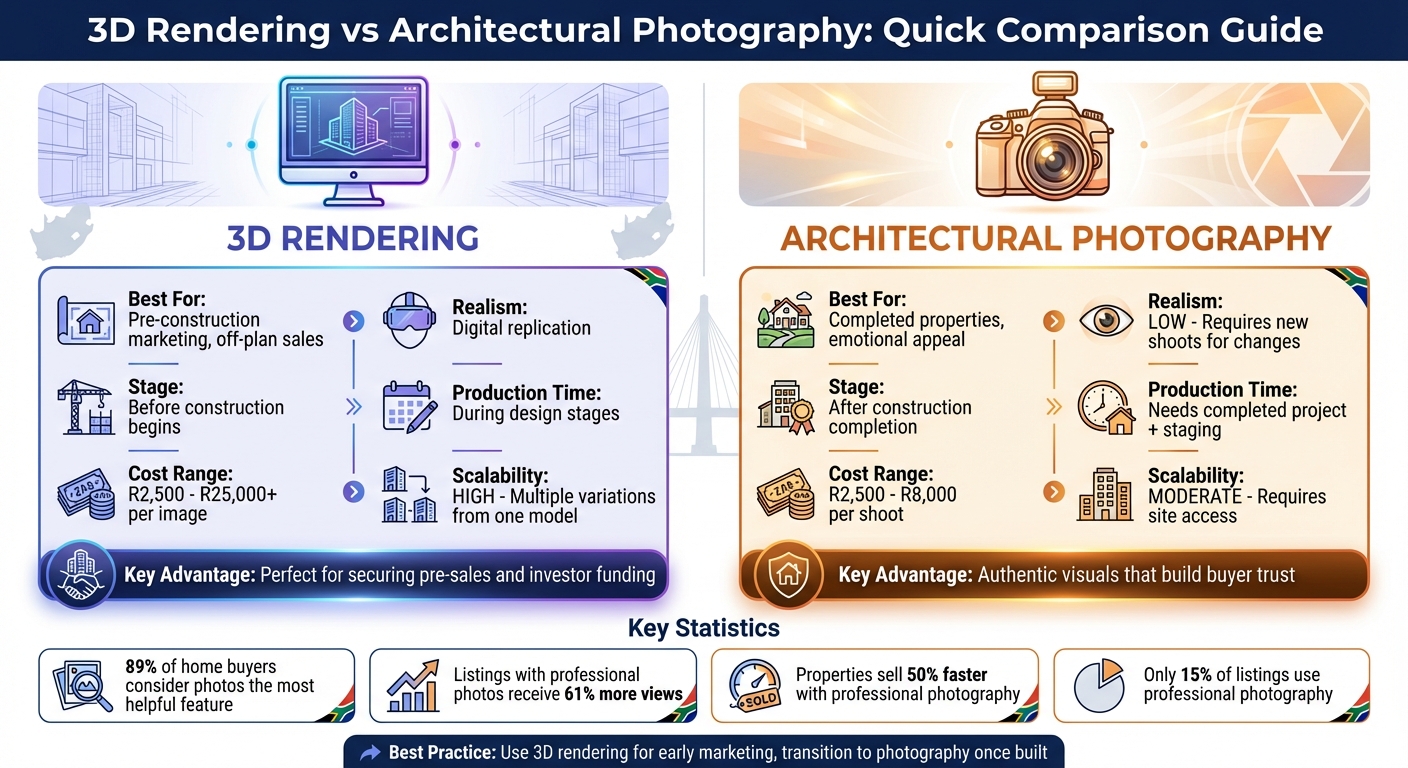
- 3D Rendering: Perfect for marketing properties before construction begins. It creates lifelike digital visuals to showcase designs, secure pre-sales, and attract investors. Costs range from R2,500 to R25,000+ per image, with flexibility for multiple variations.
- Architectural Photography: Ideal for showcasing completed properties. It highlights the physical details and lifestyle appeal of a property, helping buyers connect emotionally. Costs typically range from R2,500 to R8,000 per session.
Quick Comparison
| Feature | 3D Rendering | Architectural Photography |
|---|---|---|
| Stage of Use | Pre-construction | Post-construction |
| Cost (SA) | R2,500–R25,000+ per image | R2,500–R8,000 per shoot |
| Flexibility | High (easily modified) | Low (requires new shoots for changes) |
| Realism | Digital replication | Physical representation |
| Best For | Off-plan marketing, pre-sales | Completed properties, emotional appeal |
Both methods are valuable, but the choice depends on your timeline, budget, and target audience. Developers often use 3D rendering for early marketing and transition to photography once the property is built.
3D Rendering vs Architectural Photography Comparison for South African Property Marketing
Rendering is Like Photography – Part 1: What Makes a Good Picture? [Webinar]
What is 3D Rendering?
3D rendering, often referred to as architectural visualisation, is the process of producing high-quality, lifelike digital images or animations that bring property designs to life before construction begins. For property developers and agents in South Africa, this technology has become a game-changer, especially when marketing off-plan projects and closing early sales.
The process typically involves four main stages:
- Consultation and briefing: Discussing the project’s architectural details, design preferences, and marketing objectives.
- 3D modelling: Building detailed virtual models of the property.
- Rendering: Adding lighting, textures, and materials using advanced software to create realistic visuals.
- Feedback and adjustments: Presenting the visuals for review and making necessary refinements.
"3D rendering enables [architects] to present their designs in a highly detailed and interactive way." – Akemi Digital
In January 2026, developers like TrueProp South Africa, 1BLOK, and 2West Prop Holdings utilised 3D rendering to showcase their projects across the continent. From luxury kitchens in Cape Town to sleek, modern bedrooms in Johannesburg, these renders helped potential buyers emotionally connect with properties that were still in the planning stages. This strategy not only sparked buyer interest but also secured crucial pre-construction funding.
South African rendering services also cater specifically to the country’s needs, factoring in local architectural styles, natural lighting conditions, and the materials commonly used in different regions. Beyond residential properties, 3D rendering plays a vital role in visualising commercial hubs, retail centres, and hospitality projects. It’s used to build investor confidence, secure municipal approvals, and win competitive project bids .
Next, we’ll dive into architectural photography and its unique benefits.
What is Architectural Photography?
Architectural photography focuses on capturing completed buildings in a way that highlights their space, light, and design. Unlike 3D rendering, which imagines unbuilt projects, this type of photography brings to life the real-world details of a property – like the textures of walls, how natural light shifts throughout the day, and the materials used in construction.
Lighting plays a key role in this craft. Professional photographers know that how people perceive and interpret visuals can vary. That’s why they rely on advanced cameras designed to deliver sharp images with optimal contrast and minimal distortion, ensuring the property is presented as accurately as possible.
"Successful photographs always show the subject at least as good as it is and generally strive to make it better than it really is, which is the core of advertising photography. But the photograph must honestly reflect the property." – Anton de Beer, Photographer, Anton de Beer Photography
For property developers and estate agents in South Africa, architectural photography is the go-to option for marketing completed projects. In highly competitive areas like Cape Town and Johannesburg, standout visuals are essential for showcasing not just the property but also the lifestyle it offers. Whether it’s a luxury villa with a sleek kitchen or a modern apartment boasting an infinity pool, these images help potential buyers imagine themselves living there.
Photographers go beyond simply taking pictures – they carefully select the best times of day to shoot, ensure spaces are decluttered, and focus on elements like spatial flow, views, and natural light. This attention to detail is especially important for today’s tech-savvy South African buyers, who often research properties online before deciding to visit in person. By capturing these authentic details, architectural photography becomes a vital tool for marketing completed properties in South Africa.
Benefits of 3D Rendering
3D rendering has become an essential tool for property developers and estate agents in South Africa, especially when marketing unbuilt developments. Unlike traditional architectural photography, which requires a completed structure, rendering technology transforms blueprints into photorealistic images that showcase every design detail. This is particularly valuable in competitive hubs like Cape Town and Johannesburg, where pre-sales and international interest can determine the success of a project.
Customisation and Flexibility
One of the standout features of 3D rendering is how easily it can be tailored to different needs. Designers can quickly alter views, angles, lighting, or even entire décor schemes without having to start over. For instance, you can present multiple design options, such as varying kitchen finishes or alternative furniture layouts, in just a few hours.
This adaptability also allows developers to target diverse audiences. For luxury buyers, visuals can focus on infinity pools and high-end kitchens, while for families, communal features like gyms and gardens can take centre stage – all using the same model. In September 2024, Cape Town developers used detailed visualisations to highlight both individual unit layouts and shared spaces, helping them secure faster sales in a highly competitive market.
This ability to customise visuals not only enhances the appeal of a project but also reduces costs by avoiding the need for multiple, separate designs.
Cost Savings for Off-Plan Developments
For off-plan developments, 3D rendering offers a cost-effective alternative to traditional methods like physical staging or multiple photoshoots. It eliminates the need for weather-dependent scheduling and allows for consistent adjustments across lighting conditions, locations, and timelines. Once created, renders can be repurposed for brochures, websites, social media, or even billboards, making it easier to market multiple units within a single development.
While architectural photography in South Africa typically costs between R2 500 and R8 000 per session, with new expenses for every shoot, 3D rendering involves a higher upfront cost but minimal ongoing expenses for updates. This scalability makes it a smart choice for developers looking to maximise their marketing budgets.
Integration with New Technologies
Beyond its flexibility and cost benefits, 3D rendering works seamlessly with newer technologies to create even more engaging marketing experiences.
Features like virtual tours and dynamic animations allow potential buyers to explore unbuilt spaces, see how natural light interacts with the design, and get a feel for the flow of the rooms – all without needing to visit in person. This is becoming increasingly important in South Africa’s property market, where demand for advanced visualisation tools is growing among architects, designers, and developers.
Benefits of Architectural Photography
While 3D renderings can showcase imagined spaces, architectural photography captures the real-world essence of completed projects. It provides a genuine first impression that helps build trust with potential buyers. Professional photographers use advanced techniques to highlight details that smartphone cameras simply can’t match. This approach not only showcases the property but also taps into emotional and practical benefits.
Realism and Emotional Appeal
Architectural photography has the power to create an emotional connection, allowing buyers to picture themselves in the space. As professional photographer Anton de Beer puts it:
"When someone sees a photograph that differs a lot from that which the human eye sees, the photograph loses authenticity".
This authenticity is especially important in South Africa’s competitive property market, where 89% of home buyers using the internet consider photos the most helpful feature when deciding whether to view a property.
Professional photographers excel at using light to highlight a property’s best features. From capturing the warm tones of the Golden Hour to showcasing the textures of finishes and the flow between rooms, these images help buyers "fall in love" with a home by revealing its true character. For example, a case study by Artonic focused on a million-dollar lake property in Michigan. By highlighting the surrounding foliage and local wildlife, the photographs allowed potential buyers to imagine themselves in the tranquil setting – ultimately influencing the purchase decision.
The numbers back this up: listings with professional photos receive 61% more views on property websites, and homes with professional photography sell or rent up to 50% faster in a seller’s market. Despite this, only 15% of property listings use professional photography, giving those who do a distinct edge.
Best for Completed Projects
Photography isn’t just about emotional appeal; it also validates the quality and craftsmanship of a completed property. It highlights details like finishes and how natural light interacts with the space throughout the day. This is particularly important in cities like Cape Town and Johannesburg, where buyers often expect to see the actual property before making a decision.
Paul Wasson of FMS Sales and Leasing underscores this point:
"Professional real estate photography is definitely worth it. High-quality images help to give your property a positive first impression".
However, he adds a practical reminder:
"A picture can speak a thousand words but it can’t convince people to pay more than a property is worth".
This highlights that while professional photography enhances appeal, it works best when the property is priced appropriately and well-maintained.
3D Rendering vs Architectural Photography: Side-by-Side Comparison
In South Africa’s property market, 3D rendering is ideal for pre-construction marketing, while architectural photography is better suited for showcasing completed projects. Each approach serves a specific stage in the property development lifecycle.
The main difference lies in their timing and flexibility. 3D rendering is perfect for marketing projects still under development, offering the ability to tweak visuals – like finishes, lighting, and furniture – without extra costs. On the other hand, architectural photography captures the reality of finished structures, requiring physical setups for every shot, which can be both costly and time-intensive.
Here’s a quick comparison:
Comparison Table
| Factor | 3D Rendering | Architectural Photography |
|---|---|---|
| Suitability for Off-Plan | High; essential for pre-sales | Low; requires completed structure |
| Flexibility | High; allows digital adjustments | Low; limited to what’s physically present |
| Production Time | Can be done during design stages | Needs project completion and staging |
| Realism | High-quality digital replication | Genuine real-world visuals |
| Cost (SA) | R2 500 to R25 000+ per image, depending on complexity | Includes staging and site-visit fees |
| Scalability | High; multiple variations from one model | Moderate; requires access to each site |
| Impact in SA | Key for early investments in CT/JHB | Ideal for marketing finished luxury properties |
This table underscores how 3D rendering offers unmatched scalability. With a single digital model, developers can create multiple angles and layouts, making it especially cost-effective for large-scale projects with several units.
Drawbacks of 3D Rendering
While 3D rendering offers many benefits, it does come with its share of challenges. One of the biggest hurdles is achieving photorealism. The quality of a render hinges on the digital artist’s expertise in areas like IT, photography, and interior design. Without this blend of skills, renders can end up looking blocky or unconvincing.
As Property Studios explains, "The best CGI models cannot be differentiated between a graphic and an actual interior". However, reaching that level of realism takes a deep understanding of how to replicate real-world materials and fixtures digitally. It’s a demanding process that requires both time and money. For example, creating high-quality CGIs for just four rooms can take up to two weeks, and larger projects, like an entire development, might stretch to two months. On top of that, the briefing and plan confirmation phase can add another one to three weeks, potentially delaying the launch of marketing campaigns.
Cost is another factor to consider. Hyper-realistic interior renders typically cost around R4,500 each, while exterior renders start at R7,700. As Property Studios puts it, "with CGI images for property, you get what you pay for – as price certainly varies depending on the quality and realism of the image". Budget limitations might lead developers to settle for lower-quality visuals, which often lack the emotional depth needed to connect with potential buyers. These time and cost constraints highlight the importance of prioritising quality when opting for 3D rendering.
Another issue is the risk of "digital perfection." Unlike architectural photography, which captures the natural imperfections of real spaces, 3D renders can come across as overly polished and sterile if not done well. Additionally, generic "modern" design styles may fail to resonate with specific buyer preferences. To truly engage viewers, renders need to focus on the unique details of an interior design scheme, creating an emotional connection that feels authentic.
Recognising these limitations is crucial when weighing 3D rendering against architectural photography for property marketing strategies. Each option has its place, but understanding these challenges can help you make informed decisions.
sbb-itb-f5a6292
Drawbacks of Architectural Photography
Architectural photography has its limitations, especially when it comes to timing. Since it only captures finished projects, it delays the opportunity for marketing and generating early buyer interest. In contrast, 3D rendering allows developers to showcase a property long before construction even begins. This means traditional photography can leave developers waiting until completion to make necessary marketing adjustments.
Another challenge is the unpredictability of weather and lighting conditions. Photographers often have to wait for the perfect balance of light, which can lead to delays and extra costs. This is where 3D rendering holds an edge – it provides full control over lighting and textures, eliminating the need to rely on nature’s cooperation.
The cost of architectural photography can also add up quickly. Each photoshoot comes with expenses like studio rentals, props, and editing. If changes are needed – such as a new angle, a different staging setup, or an alternate room configuration – a fresh shoot is required, further driving up costs. Staging, too, adds to the bill, including costs for furniture, props, transportation, and detailed post-production work. Once the images are taken, they’re static; any major changes, such as altering finishes or layouts, mean starting from scratch with a new photoshoot.
For off-plan developments, architectural photography falls short. Buyers need to see detailed representations of spaces, including room dimensions and the overall flow of a property – something only 3D rendering can deliver. Without such visuals, potential buyers are left to rely on promises rather than tangible evidence, which can slow down sales in competitive markets. Unlike photography, which captures a single moment, 3D rendering can adapt instantly to design changes, offering a more dynamic and flexible solution.
Cost and Scalability in South Africa
In South Africa’s property market, understanding the cost differences between 3D rendering and architectural photography is essential for developers working within tight budgets. Architectural photography typically costs between R2,500 and R8,000 per shoot. While this might seem manageable initially, the expenses can quickly add up. Every time new images are needed – whether for different units, seasonal updates, or design changes – developers must organise additional shoots. This means hiring photographers, staging properties, and waiting for favourable weather, all of which drive up costs over time.
On the other hand, 3D rendering involves a higher initial outlay but offers significant savings in the long term. Basic renders are priced between R2,500 and R10,000 per image, medium-complexity projects range from R10,000 to R25,000, and photorealistic renders for high-end developments start at R25,000 and above. The real advantage lies in the flexibility: once a digital model is created, modifications are far less expensive than organising another photoshoot. This makes 3D rendering particularly cost-effective for larger developments that require showcasing multiple unit variations.
Another key benefit of 3D rendering is scalability. A single digital model can produce countless images showing different layouts, finishes, and unit types – all without needing additional site visits or staging. Leading South African developers like 1BLOK, TrueProp South Africa, and The Property Advisory already rely on this scalability to enhance their projects.
However, pricing for 3D rendering varies across regions. Firms in Cape Town and Johannesburg tend to charge more due to higher demand and local operating costs. These providers also have a deep understanding of South African architectural styles and buyer preferences, ensuring the visuals appeal to local audiences.
This regional pricing dynamic has driven a growing demand for scalable solutions, particularly in major cities like Cape Town and Johannesburg. Developers are increasingly turning to 3D rendering to support extended marketing campaigns. For those deciding between visual marketing options, this cost and scalability comparison provides valuable insight.
The best approach often depends on the project stage. Basic, lower-cost renders work well for early concepts, while hyper-realistic imagery is ideal for luxury developments. Architectural photography remains a practical choice for single, completed properties that need quick promotional materials. However, for off-plan developments requiring consistent marketing across multiple units and long sales cycles, 3D rendering offers better value in the long run.
When to Use 3D Rendering for SA Property Marketing
3D rendering is a game-changer for marketing properties that haven’t been built yet. In South Africa, developers rely on it to secure early sales for off-plan projects. Without physical properties to photograph, these rendered visuals fill the gap, giving potential investors something tangible to consider. This approach helps bridge the gap between planning and construction, offering a fresh way to market properties.
Virtual tours are another standout use. In cities like Cape Town, immersive CGI walkthroughs allow potential buyers to explore unbuilt properties interactively. This is a huge benefit for international buyers who can’t visit in person, as well as for reducing the need for physical show units.
The technology also shines when it comes to multiple unit variations. Developers can create several unit options from a single model, which is incredibly useful for large residential complexes or sectional title developments. Buyers can compare different layouts or finishes without needing to see each one physically.
For projects with tight deadlines, 3D rendering is a lifesaver. Time-sensitive projects benefit greatly because marketing materials can be generated directly from architectural plans. This speeds up approvals and helps build buyer interest even before construction begins. It’s a smart way to secure pre-sales and attract financing early on, making it a cost-efficient and flexible solution.
Finally, 3D rendering works well with new technologies like animations and interactive 3D floor plans. These tools offer more engaging presentations than static images, helping developers stand out in competitive markets like Johannesburg and Cape Town. With demand for cutting-edge property marketing on the rise, these features give developers an edge.
When to Use Architectural Photography for SA Property Marketing
Architectural photography becomes essential once a property is fully constructed and finished. Unlike 3D renderings, which present a digital concept, photography captures the real structure, giving potential buyers a clear and tangible view of what they’re purchasing. In competitive markets like Johannesburg and Cape Town, this authenticity can be the deciding factor in closing a sale. For premium properties, the advantages are even more pronounced.
High-end luxury properties benefit immensely from professional photography. Whether it’s a luxury villa in Johannesburg or a sophisticated apartment in Cape Town, high-quality images bring out the textures, finishes, and natural lighting that create emotional appeal. As Sue Formanowicz, a satisfied seller, shared:
"The photographs have managed to capture the depth & essence of the house… considering that the house is empty."
This ability to evoke emotion through visuals is crucial for showcasing luxury homes.
Staged show homes and rental listings also rely heavily on professional photography. Once a show home is staged, photography captures the lifestyle and flow of the space, helping potential buyers or tenants envision themselves living there. For rental properties or homes ready for immediate occupancy, listings with professional images consistently outperform those without. Despite this, only about 15% of listings include professional photos, giving those that do a clear edge in the market.
Commercial developments in key areas like Sandton or the Cape Town CBD also gain from professional photography. Finished buildings need to highlight their scale, design, and integration into their surroundings. Authenticity is key here, as buyers are drawn to properties that feel genuine and connected to their environment.
Beyond showcasing completed structures, photography plays a vital role in highlighting unique architectural details. South African architecture often incorporates materials like stone, bamboo, and brick, which blend beautifully with the country’s varied landscapes. Professional photography captures these textures and the way natural light interacts with them. Architect Enrico Daffonchio of Daffonchio & Associates Architects puts it best:
"Building materials and structural elements are meant to be shown with integrity as graphic and sculptural patterns."
This focus on genuine textures and materials makes architectural photography indispensable for properties with standout design features. It’s not just about selling a property – it’s about telling its story through visuals.
3D Rendering Services South Africa: Tailored Solutions for Property Developers
For developers across South Africa, 3D Rendering Services South Africa delivers specialised visualisation solutions tailored to local property projects. These services are designed to support modern property developments by producing high-quality 3D renders and marketing visuals. This helps developers secure investments, sell off-plan units, and stand out in competitive markets like Johannesburg, Cape Town, and Sandton.
Their offerings include a wide range of services: exterior and interior renders, commercial renders, virtual staging, detailed floor plans, VR solutions, and comprehensive marketing support. The latter covers branding, web development, social media, and collateral design, providing developers with a complete digital representation of their projects before construction even begins.
What sets this service apart is its focus on the South African market. By collaborating with local property advisory firms, the team creates marketing assets that resonate with South African buyers and investors. Their portfolio features collaborations with well-known names like TrueProp South Africa, 1BLOK, 2West Prop Holdings, The Property Advisory, ARCIS, and Africar Group, showcasing their proven track record.
Pricing is structured to accommodate various project scales. For example, interior CGI images typically cost around R4,500 each, while exterior CGI images start at R7,700 per image. For larger developments, a full suite of services may take up to two months to complete, with lead times ranging from one to three weeks. Developers are encouraged to place orders as soon as planning approval is secured to make the most of the pre-construction marketing window.
To enhance its appeal, the platform allows developers to filter portfolios by property sector – be it commercial, residential, or lifestyle-focused. This ensures that the marketing visuals align closely with the goals of each specific project. Beyond showcasing the physical structure, these tailored visuals highlight the lifestyle and experience the development offers, helping potential buyers imagine themselves living in the space.
Choosing the Right Option for Your Marketing Goals
Deciding between 3D rendering and architectural photography often comes down to the stage of your project and your specific marketing needs. For developments still in the planning phase, 3D rendering is a must-have tool. It lets you visualise and promote a project that hasn’t been built yet, helping to secure pre-sales and bring the vision to life long before construction begins. On the other hand, architectural photography works best for completed properties, showcasing real-world details and the lived-in charm that builds buyer confidence.
Your budget and the ability to scale are also key factors. While 3D rendering might require a larger upfront investment due to the digital modelling process, the assets can be reused or modified for future needs, potentially saving costs over time. Photography, however, comes with repeated expenses for every new shoot, which can add up quickly, especially for larger developments with multiple units.
The choice also depends on your audience. For high-end markets in cities like Johannesburg or Cape Town, photorealistic 3D renders can emphasise luxurious features – think infinity pools or sleek modern interiors – appealing to affluent buyers or international investors who may not be able to visit in person. Meanwhile, architectural photography is ideal for creating an emotional connection with buyers who value the authenticity and warmth of a finished property.
A balanced approach often yields the best results. Developers frequently start with 3D renders to market off-plan properties, showcase design options, and generate excitement. Once a show unit or the final build is ready, transitioning to professional photography helps solidify trust by presenting the completed reality. This strategy allows you to maximise the strengths of both methods.
If you need to visualise unbuilt spaces, adapt quickly, or get to market faster, 3D rendering is your go-to option. But if you’re showcasing a finished property and want to highlight its real-world appeal, architectural photography becomes essential.
FAQs
How do the costs of 3D rendering and architectural photography compare for property marketing in South Africa?
The costs of 3D rendering and architectural photography in South Africa vary widely because they serve different purposes and require distinct production methods.
3D rendering typically ranges from R2 500 to R25 000+ per image, influenced by factors like the level of detail, image quality, and optional extras such as virtual tours or animations. While the initial price may seem steep, 3D renders offer flexibility, customisation, and the unique advantage of marketing properties even before construction begins.
In contrast, architectural photography is usually more budget-friendly, with prices between R2 000 and R5 000 per shoot. The cost depends on factors such as the property’s location, its size, and the amount of editing required. This option is perfect for showcasing completed properties, as it reflects actual conditions and involves less pre-production effort.
In summary, 3D rendering works best for pre-construction marketing and long-term campaigns, while architectural photography provides a more economical choice for promoting finished projects.
How can 3D rendering assist in marketing properties that are still under development?
3D rendering is an incredible way to bring unbuilt properties to life. It delivers highly detailed and lifelike visuals, helping potential buyers imagine the design, layout, and atmosphere of a space long before construction begins. This visualisation often creates an emotional connection, making the project feel more tangible.
By tackling common questions about space, functionality, and style, 3D renders make it simpler for developers and agents to share their vision. They also shine a spotlight on standout features and selling points, making the property even more attractive to its intended audience.
When should I choose architectural photography instead of 3D rendering for property marketing?
Architectural photography shines when it comes to showcasing fully completed and furnished properties. By capturing the true essence of a space, it helps convey its atmosphere and character, fostering trust and sparking an emotional connection with potential buyers.
This style of photography is particularly suited for marketing properties where the physical setting, natural lighting, and finer details play a pivotal role. It’s especially impactful for luxury homes, boutique developments, or properties with standout architectural features that deserve to be seen in their purest form.
Related Blog Posts
- 3D Rendering vs Traditional Photography: What Works Best in South Africa?
- Best Architectural Rendering Styles for South African Projects
- How We Deliver Fast, Affordable 3D Renders Across South Africa
- 3D Property Rendering South Africa: Pricing, Turnaround & Examples

