

Selling property before construction starts can be tough, especially when buyers can’t physically see what they’re committing to. In Johannesburg’s competitive property market, architectural rendering has proven to be a game-changer. By transforming blueprints into lifelike 3D visuals, developers can showcase homes in a way that feels real and relatable, helping buyers picture themselves in the space. This approach not only boosts pre-sales but also builds trust and confidence.
Key Takeaways:
- What It Is: Architectural rendering creates 3D visuals of properties, making it easier to sell off-plan homes.
- Why It Matters: Johannesburg’s property market demands standout marketing to secure early sales. High-quality renders show buyers the lifestyle they’re investing in.
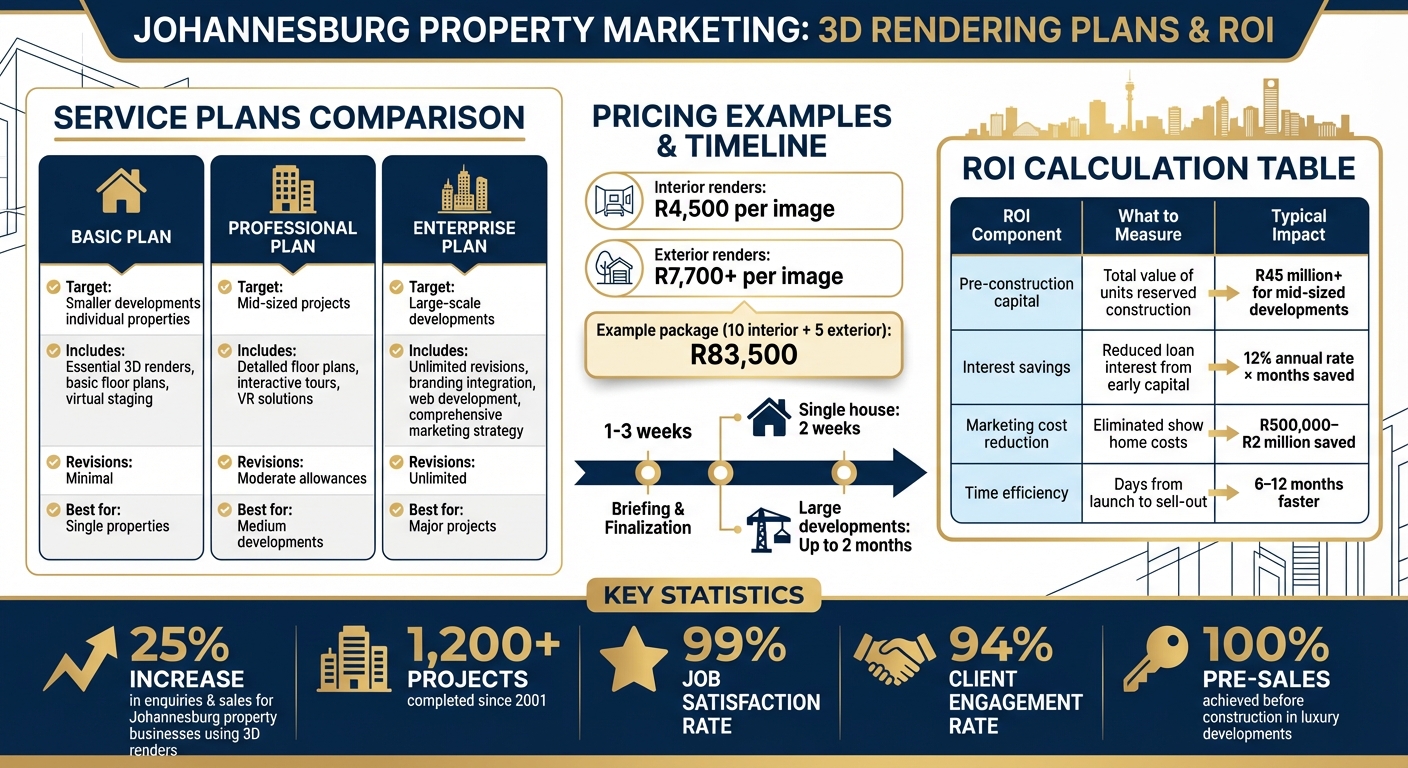
- Costs & Timelines: Interior renders cost around R4,500 per image, while exterior renders start at R7,700. Completing renders for a single house can take two weeks, while larger developments may take up to two months.
- Techniques That Work:
- Photorealistic renders capture sunlight, textures, and local design elements.
- Aerial views and 360-degree tours offer immersive experiences.
- Tailored designs reflect Johannesburg’s unique architectural styles, from Art Deco to Sandton’s sleek modern look.
- Proven Results: Developments using 3D renders often sell out faster, saving on interest costs and reducing marketing timelines.
Architectural rendering isn’t just a visual tool – it’s a way to make off-plan properties feel tangible, helping developers in Johannesburg secure early commitments and stand out in a crowded market.
Portwood by Edgar Development | Interactive 3D Master-Planned Community | SmartPixel
Proven Methods for Using 3D Rendering to Sell Off-Plan Properties
3D rendering has the power to turn abstract blueprints into something buyers can emotionally connect with. By helping potential buyers imagine themselves in a space that hasn’t yet been built, it builds confidence and encourages early commitments. Let’s dive into how photorealistic renders can reflect local character and drive sales.
Creating Photorealistic Exterior and Interior Renders
Photorealistic renders take the guesswork out of visualising a home. By accurately depicting sunlight, textures, and spatial proportions, they make up for the absence of a physical walkthrough.
In Johannesburg, though, generic modern designs won’t cut it. Buyers here expect renders that reflect the city’s unique style, such as grand entrances and sleek, contemporary interiors. Materials like polished yellowwood, brass details inspired by the city’s mining history, and CBD-style marble finishes evoke a sense of place .
"In Johannesburg’s high-end real estate market, visual appeal is crucial. Villa Renders Johannesburg ensures that luxury properties stand out… highlighting every intricate detail, from the grandeur of the entrance to the elegance of the interior spaces." – PropertyRender
Johannesburg’s environment also plays a key role. The Highveld’s intense sunlight creates striking light-and-shadow effects on textured walls, which renders should capture. Including local elements – like the lush urban forest canopy in the northern suburbs – helps buyers feel an emotional connection to the property. For high-density developments, showcasing shared spaces like gyms, lobbies, and gardens can further reassure buyers about the quality and value of the project.
Using Aerial Views and 360-Degree Tours
Aerial renders give buyers a clear sense of how a development fits into its surroundings. Whether it’s nestled near Sandton’s gleaming skyscrapers or framed by the Art Deco charm of the CBD, these views provide essential context.
Interactive 360-degree virtual tours take it a step further, allowing buyers to explore layouts and room flow at their own pace. These tools bridge the gap between a developer’s vision and a buyer’s experience, making off-plan projects feel tangible and compelling enough to drive pre-sales.
Adding Johannesburg Design Elements to Renders
Incorporating local architectural features is key to earning buyer trust. Johannesburg boasts the world’s third-largest collection of Art Deco buildings, after New York and Miami. For developments in these areas, integrating design elements like curved facades, geometric patterns, and maritime-inspired porthole windows creates an immediate sense of familiarity .
"Art Deco is the birth of a flower; it was a movement of ideas, an architecture of buds; curls, swirls, and newborn petals." – Barbara Adair
Different suburbs require tailored approaches. For instance, Cape Dutch elements – such as ornate gables, whitewashed walls, and thatched roofs – work well in areas like Craighall Park or Auckland Park. In contrast, luxury developments in Sandton should embrace the sleek glass-and-steel aesthetic that defines its skyline.
Material choices also matter. Textures and finishes tied to Johannesburg’s architectural identity – like the rough plaster walls that reflect the Highveld sun or the high ceilings of historic buildings – make renders feel authentic. These thoughtful details not only build credibility but also help buyers picture themselves living in the space, speeding up their decision-making process .
How 3D Rendering Services South Africa Supports Off-Plan Marketing
3D Rendering Service Plans and ROI Comparison for Johannesburg Property Developers
Since 2001, 3D Rendering Services South Africa has completed over 1,200 projects, maintaining a 99% job satisfaction rate. Their blend of technical expertise and marketing insight ensures that every architectural visualisation enhances off-plan property marketing efforts in Johannesburg. This dedication is evident in their customised service plans.
Service Plans and What They Offer
The company provides three distinct plans to cater to various project needs:
- Basic Plan: Perfect for smaller developments or individual properties, this plan includes essential 3D renders, basic floor plans, and virtual staging. It’s designed for projects with minimal revision requirements.
- Professional Plan: This option is ideal for mid-sized projects, offering detailed floor plans, interactive tours, VR solutions, and moderate revision allowances.
- Enterprise Plan: Geared towards large-scale developments, it includes unlimited revisions, branding integration, web development, and a comprehensive marketing strategy.
Turnaround times and pricing depend on the project’s size and complexity, aligning with industry norms. Developers are advised to order Computer-Generated Imagery (CGIs) as soon as planning approval is granted, as the process typically requires one to three weeks for briefing and finalising finishes.
Comprehensive Marketing for Johannesburg Developments
Beyond creating visually stunning renders, the service integrates these into complete marketing packages. These include 3D brand activations, professional photography, and CGI site plans that highlight communal spaces and the overall development layout. For off-plan projects, virtual staging is tailored to specific buyer personas, avoiding generic styles and fostering stronger emotional connections.
"A 3D rendering can beautifully showcase your designs while emphasizing their full potential vibrantly and cost-effectively." – 3D Rendering South Africa
The company also offers advanced plot locators connected to backend CRM systems, allowing real-time tracking of buyer activity and plot updates. With high-quality CGIs, developers can often secure reservations for all units before construction even begins.
Flexible Revisions for Tailored Results
The rendering process involves detailed briefing documents, ensuring developers are actively involved at every stage. The Enterprise Plan, in particular, stands out with unlimited revisions, making it ideal for projects requiring multiple adjustments to meet architectural details or buyer feedback. This adaptability ensures that the final renders reflect local design preferences and align with Johannesburg’s unique urban aesthetic.
"Hyper-realistic 3D rendering is the tool for developers to sell (or reserve) their units off-plan before a single brick has been laid." – Property Studios
Operating from their Cape Town headquarters, the company serves clients across Johannesburg, Port Elizabeth, and Durban. With a 94% client engagement rate, their tailored approach continues to deliver effective results.
sbb-itb-f5a6292
Case Studies: Off-Plan Projects in Johannesburg That Used 3D Rendering
Johannesburg has seen how architectural rendering can transform ideas into fully sold-out developments. These examples highlight how 3D rendering has delivered tangible results across various property markets.
High-Density Residential Development
The Student Housing Johannesburg project utilised photorealistic CGI to market hundreds of units before a single brick was laid. Once planning approval came through, the development team quickly commissioned renders, enabling pre-sales to kick off immediately. Interior CGI images emphasised practical layouts tailored for student living, while exterior visuals showcased communal study spaces and secure access points, appealing directly to the target market.
Similarly, the Affordable Housing Johannesburg project focused on connecting with buyers through persona-driven interior design. Instead of generic modern aesthetics, the renders were customised to reflect the preferences of the target demographic. This approach created an emotional connection that traditional 2D plans simply couldn’t achieve. Over two months, the team produced renders for a variety of unit types, bridging the gap between the developer’s vision and the buyer’s commitment.
Luxury developments, on the other hand, have used these advanced rendering techniques to captivate a more exclusive audience.
Luxury Apartment Marketing Campaign
A high-end residential project aimed at Sandton’s affluent buyers leveraged 360-degree virtual tours and detailed interior renders to highlight features like infinity pools, cutting-edge kitchens, and expansive open-plan living spaces. These visuals played a key role in securing full pre-sales.
The marketing campaign launched while the site was still being cleared, giving the sales team a significant six-month head start. Landscaped CGI gardens and meticulously designed interiors didn’t just sell square metres – they sold a lifestyle. This strategy resulted in 100% of the units being reserved before construction even began. The quick turnaround of initial marketing renders also allowed the development team to gauge buyer preferences and make adjustments to finishes before finalising construction details.
Measuring Results from Architectural Rendering Campaigns
To gauge the success of your 3D visualisation efforts, focus on tracking key performance metrics. One of the clearest indicators is pre-sale and reservation rates – essentially, how many units are sold or reserved before construction even begins. High-quality computer-generated images (CGIs) have been known to drive full pre-sales ahead of breaking ground, showcasing just how impactful photorealistic visuals can be.
Another essential metric is lead generation. By pairing a plot locator with a backend CRM system, you can pinpoint exactly how many inquiries stem directly from your renders. This setup not only tracks which units potential buyers are interested in but also reveals how many of those inquiries convert into serious reservations. The ratio of inquiries to reservations offers a clear picture of whether your renders are drawing in serious buyers or merely casual browsers.
Time-to-market efficiency is another critical angle to consider. Compare how quickly units sell in developments using high-quality renders versus older projects that relied on traditional marketing techniques. Properties marketed with photorealistic CGIs tend to sell faster, avoiding lengthy stays on the market. This accelerated sales cycle reduces carrying costs and improves overall project profitability. In some cases, developments have sold out much quicker simply by launching campaigns earlier, further proving the value of architectural renders.
These metrics are particularly valuable in the competitive property market of Johannesburg, where speed and precision can make all the difference.
Tracking Conversion Rates from Rendering Campaigns
Once your renders go live, it’s time to measure their impact using targeted metrics. One advantage of 3D renders is the ability to launch campaigns quickly – often within one to three weeks after planning approval. This early start, compared to the months it takes to prepare a physical show home, can result in faster capital inflow and reduced interest on construction loans.
Engagement data from your digital platforms is another crucial metric. Which room designs are being saved or shared the most? Are certain exterior views driving more contact form submissions? This type of feedback can reveal what resonates most with your audience. For example, renders for apartment developments often generate high interest when they highlight communal areas or secure access. Meanwhile, luxury developments tend to see strong engagement with features like infinity pools and high-end kitchen designs.
Geographic data is equally important. High-quality renders allow you to connect with international buyers who can’t visit the site in person. By tracking whether inquiries are coming from local or international markets, you can assess the reach of your renders and adjust your marketing budget accordingly.
Once you’ve gathered data on conversion rates, compare these results to your initial rendering investment to evaluate the overall effectiveness of your campaign.
Calculating ROI for Architectural Rendering
Determining the return on investment (ROI) for your renders involves comparing the upfront cost of the visuals to the financial benefits they generate. For example, producing ten interior and five exterior renders might cost around R83,500.
Now, consider the potential return. If these renders help you pre-sell 30 units at an average price of R1.5 million each, you’ve secured R45 million in capital before construction even begins. Beyond the immediate sales, early capital injection leads to significant interest savings. At a 12% annual loan rate, securing R45 million six months earlier could save you approximately R2.7 million in interest.
Time savings also play a role in ROI. If your renders help you sell out a development in six months instead of eighteen, you eliminate a full year’s worth of marketing, holding, and opportunity costs. By tracking these financial benefits against your initial rendering investment, you can calculate the true value of your campaign.
| ROI Component | What to Measure | Typical Impact |
|---|---|---|
| Pre-construction capital | Total value of units reserved before construction | R45 million+ for mid-sized developments |
| Interest savings | Reduced loan interest from early capital | 12% annual rate × months saved |
| Marketing cost reduction | Eliminated costs for constructing and maintaining show homes | R500,000–R2 million saved |
| Time efficiency | Days from campaign launch to sell-out | 6–12 months faster than traditional methods |
Conclusion
Architectural rendering has reshaped off-plan marketing in Johannesburg by converting abstract ideas into lifelike visuals that drive pre-sales and build trust with potential buyers.
Incorporating 3D renders into marketing materials has been shown to increase enquiries and sales by 25% for Johannesburg-based property businesses. As Property Render puts it:
"Architectural visualisation has become the backbone of project marketing, particularly in the South African property market".
This level of success has pushed developers to adopt rendering technology faster than ever. The conversation is no longer about whether to use architectural rendering but how quickly it can be implemented to meet buyers’ expectations. Whether it’s high-density housing in Soweto or luxury apartments in Sandton, photorealistic renders give buyers the confidence to commit early.
3D Rendering Services South Africa offers tailored solutions for Johannesburg developments. Their services range from basic renders to advanced marketing tools like virtual staging, 3D floor plans, and VR experiences. With flexible revision options and packages designed specifically for off-plan marketing, developers can present their projects with the precision and quality that today’s buyers demand.
In a competitive property market like Johannesburg, high-quality architectural visualisation not only highlights the features of a development but also paints an aspirational picture of what’s to come – helping developers overcome off-plan marketing challenges with ease.
FAQs
How do architectural renders help build buyer trust in Johannesburg’s property market?
Architectural renders offer potential buyers a lifelike glimpse into properties long before construction wraps up. These visuals go beyond mere blueprints by illustrating precise room sizes, lighting effects, material textures, and the overall layout. This level of detail helps remove the guesswork often tied to buying off-plan, allowing buyers to imagine living in the space. The result? A stronger emotional connection and greater confidence in the investment.
Properties listed with 3D renders tend to draw more attention, sell faster, and often fetch higher prices. In Johannesburg’s competitive property market, these striking visual tools play a vital role in building trust, speeding up decisions, and delivering better returns for developers.
What advantages does 3D rendering offer for selling off-plan properties in Johannesburg?
3D rendering offers property developers dynamic visuals that bring architectural plans to life, turning them into realistic, market-ready images. These visuals play a crucial role in capturing buyer interest by helping potential clients picture the completed property, fostering an emotional connection that can lead to quicker decision-making.
By incorporating 3D renders, developers can cut marketing costs while achieving better outcomes. For instance, virtual staging costs range from R550 to R1 400 per image, a fraction of the R28 500 to R95 000 typically spent on traditional staging. Despite the lower cost, virtual staging can boost online views by up to 87% and generate 40% more buyer enquiries. Properties promoted with 3D visuals tend to sell 20% to 31% faster and command 6% to 10% higher prices compared to those using conventional marketing materials.
Interactive features like virtual walkthroughs and clickable floor plans are particularly appealing to South African buyers, offering an effortless way to explore properties. This technology can pre-sell as much as 70% of units before construction even begins, improving cash flow and minimising financial risks for developers.
How do photorealistic renders showcase Johannesburg’s unique architecture?
Photorealistic renders capture the essence of Johannesburg’s architectural style by showcasing the city’s signature materials, shapes, and natural light. Whether it’s the warm tones of red-brick façades, the textured appeal of stone cladding, sleek glass curtain walls, or the industrial charm of corrugated-metal roofs, these renders bring Jo’burg’s unique developments to life with striking detail.
They also reflect the city’s high-altitude light, recreating the sharp contrasts and golden hues that define Johannesburg’s sunny days and magical golden hours. By including familiar elements like the city’s skyline, bustling streetscapes, and local vegetation, these visualisations create a sense of place, making off-plan properties feel deeply connected to their environment. This mix of lifelike detail and local context makes the renders a powerful tool for showcasing unbuilt properties.
Related Blog Posts
- Save Up to 30% on Marketing Costs with High-Quality 3D Renders
- How to Market Off-Plan Developments in South Africa with 3D Renders
- Best Architectural Rendering Styles for South African Projects
- How 3D Renders Help Developers in Gauteng, Cape Town & Durban Close Deals Faster

