

Selling property off-plan in South Africa is challenging without visuals that resonate. High-quality CGI renders solve this by turning technical drawings into lifelike images that showcase homes and lifestyles. These visuals help secure pre-sales, especially for estates and gated communities, where buyers value security, outdoor living, and shared spaces. Developers can use tools like V-Ray, Lumion, and 3ds Max to create renders tailored to South African climates, lifestyles, and preferences. Costs for renders start at R4,500 for interiors and R7,700 for exteriors, with timelines ranging from two weeks to two months. The key is to focus on lighting, local landscaping, and security features while offering immersive experiences like virtual tours and interactive site plans. This approach helps developments stand out in competitive markets like Cape Town and Johannesburg.
Realistic Exterior Archviz In Blender | Beginner Architecture tutorial
What South African Gated Communities Need in CGI Renders
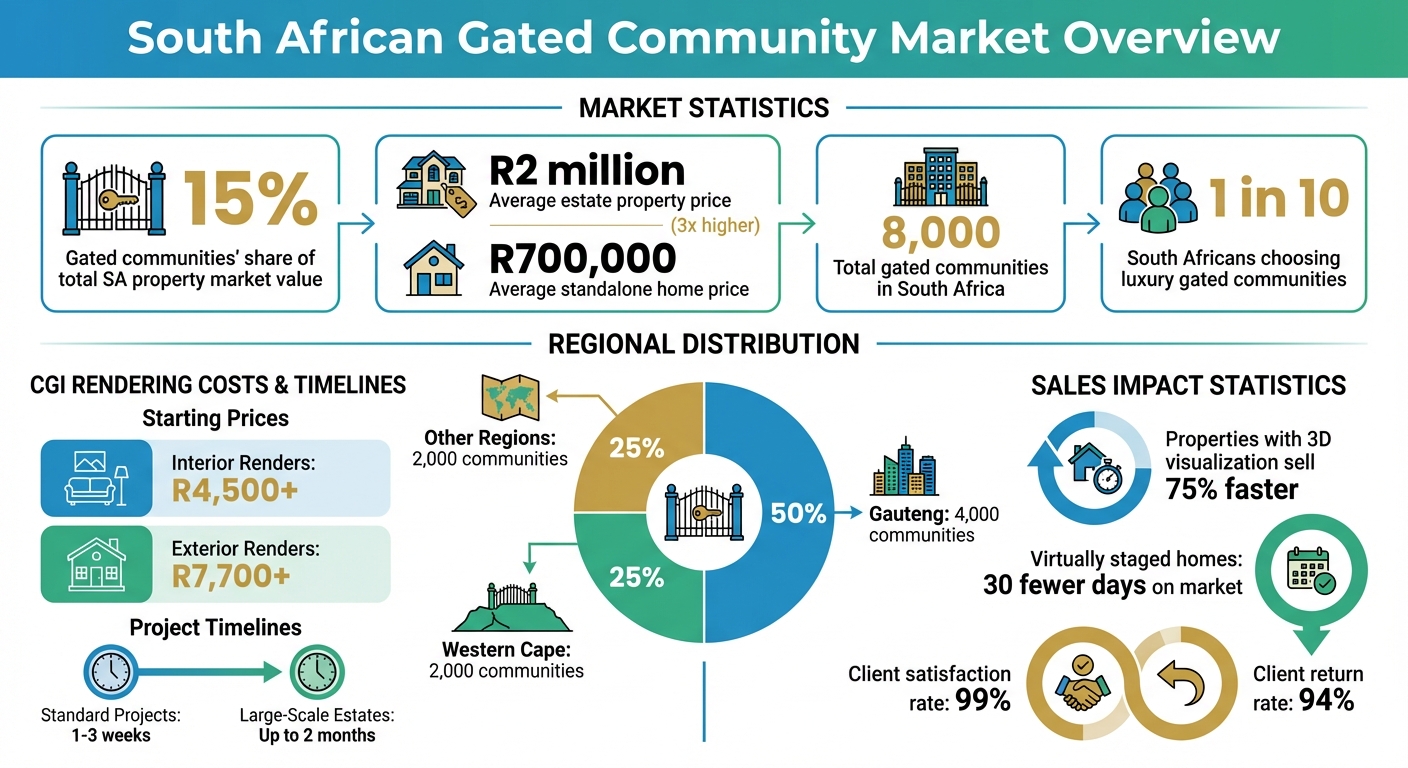
South Africa Gated Community Market Statistics and CGI Rendering Costs
South African property buyers are looking for more than just a house – they want a lifestyle. And in gated communities, this means a focus on security, outdoor living, and shared spaces that foster a sense of togetherness.
"In South Africa, the concept of ‘home’ is evolving. For many buyers, security remains a top priority, but gated communities and lifestyle estates have become much more than just safe havens." – Reese Van Niekerk, Author, Amazing Spaces
The stats back this up. Gated communities account for 15% of the total property market value in South Africa. The average estate property is priced at R2 million, nearly three times the R700,000 average for standalone homes. Gauteng leads the way with half of the country’s 8,000 gated communities, while the Western Cape claims a quarter. For developers in these regions, it’s crucial to create renders that align with the expectations of buyers in cities like Johannesburg and Cape Town.
Let’s unpack what makes CGI renders stand out for South African buyers.
Design Elements That Appeal to SA Buyers
A generic "modern" look just doesn’t cut it anymore. South African buyers want renders that reflect their unique lifestyles and needs. For example, a young professional browsing apartments in Cape Town has vastly different priorities compared to a family of four searching for a spacious townhouse in Johannesburg.
Here’s where renders can shine: showcase landscaped gardens that are perfect for summer braais, family gatherings, and laid-back outdoor living. Buyers want to see spaces that feel alive – think outdoor furniture setups, built-in braai areas, and lush, inviting gardens.
It’s also important to highlight regional lifestyles. In Cape Town, focus on modern communal amenities, while Johannesburg buyers might be drawn to luxurious family-friendly settings. Use clear 3D floor plans to help buyers visualise how private spaces connect seamlessly to shared areas. Interactive site plans with clickable unit locators are another great way to engage potential buyers.
But it’s not just about aesthetics. Security and sustainability are equally important to South African buyers.
Lifestyle and Security Expectations
For many buyers, security is the deciding factor. In fact, one in ten South Africans opts for a luxury gated community when choosing a home. However, your renders need to strike a delicate balance – showcasing security features without making the community feel cold or overly fortified.
Include visuals of 24/7 manned gatehouses, CCTV-monitored entry points, and other security measures that blend into the overall design. Highlight amenities that promote a sense of community, such as fenceless internal properties, shared parks, and open spaces that encourage neighbourly interaction.
Modern gated estates are more than just homes; they’re self-contained lifestyle hubs. Use your renders to showcase jogging trails, cycling paths, golf courses, equestrian facilities, and clubhouses. For premium developments, include private schools, on-site clinics, and retail centres in your site plans to emphasise convenience. Virtual tours with interactive labels pointing out nearby facilities like hospitals and malls can also address buyers’ practical concerns.
Sustainability is another key focus. Buyers are increasingly drawn to eco-friendly features. Renders should include solar panels, wind turbines, and water-saving systems to appeal to those prioritising greener living. Some estates even go a step further, integrating mini nature reserves with live game – offering residents a tranquil escape from urban life.
Lastly, don’t overlook the finer details. Features like speed bumps or 40km/h signage in renders can reassure family-focused buyers that the estate prioritises safety for children and pets. These small touches can make a big difference in how a development is perceived.
Software and Tools for Professional CGI Renders
Creating top-tier CGI renders for estate and gated community projects in South Africa often involves using tools like V-Ray, Lumion, and Autodesk 3ds Max. Each of these software options brings something unique to the table, whether it’s architectural modelling, photorealistic lighting, or real-time landscape visualisation.
The software you choose affects not just the visual quality of your renders but also how quickly you can deliver them. For large-scale estate developments, where timelines can stretch up to two months to produce a full suite of plot types and sample renders, balancing efficiency with visual detail is critical. Leading South African firms like SAOTA and Paragon Architects rely on these tools to showcase their projects locally and in over 86 countries. Let’s break down what makes each tool stand out.
V-Ray for Photorealistic Rendering
V-Ray is widely regarded as the gold standard for creating hyper-realistic renders. Its use of realistic lighting, materials, and cameras allows developers to present projects with stunning accuracy. For estate developers, this means you can show potential buyers exactly how sunlight interacts with a property throughout the day – a crucial selling point in South Africa’s sunny climate.
Some standout features include:
- Light Gen: Automatically generates various natural lighting scenarios.
- Sun Animation: Perfect for solar studies, showcasing how north-facing living areas capture morning light or how shaded courtyards offer cool relief during hot afternoons.
- Chaos Cosmos: A library of ready-to-use 3D models tailored to reflect South African lifestyles.
- Object Scattering: Quickly populates large terrains with grass, rocks, and trees, saving hours of manual work.
Additionally, V-Ray supports 360-degree panoramas and virtual reality content, enabling buyers to explore gated communities at a life-size scale. For developers targeting high-end clients who expect immersive experiences, these features are indispensable.
Lumion for Landscape and Environment Visualisation
Lumion excels at turning CAD models into vivid, lifelike environments. It’s particularly useful for large estate layouts and communal spaces where speed is a priority. Cape Town-based design firm SAOTA describes Lumion as essential, praising its ability to streamline workflows from concept to completion.
"Lumion has allowed us to deliver high quality visualisation media in an ‘easy to use’ workflow which cannot be easily matched by other software packages." – Emile Maritz, Professional User
Key features include:
- LiveSync: Keeps a live connection between CAD tools like Revit or SketchUp and Lumion, allowing real-time previews of design changes. This feature is especially helpful during client presentations when instant feedback is needed.
- Sun Studies: Simulates precise lighting conditions for specific South African locations, ensuring renders align with local sunlight patterns.
- AI Image Upscaler: Produces high-resolution renders (up to 8K) up to five times faster than traditional methods.
Lumion also boasts an extensive asset library, including over 147 models designed for family-friendly and educational spaces. This makes it ideal for visualising community centres, playgrounds, and shared amenities.
Autodesk 3ds Max for Architectural Modelling
Autodesk 3ds Max is the backbone of architectural modelling, providing the intricate geometry needed for upscale estate designs. It integrates seamlessly with V-Ray, making it a powerful tool for managing detailed estate layouts.
For large-scale projects with diverse plot types, 3ds Max offers the flexibility to model everything from townhouses to clubhouses. It’s the foundation upon which V-Ray’s photorealistic rendering and Lumion’s real-time visualisation capabilities are built.
| Feature | V-Ray | Lumion |
|---|---|---|
| Primary Strength | Photorealistic rendering | Real-time visualisation |
| Best For | Final marketing imagery & VR | Concept design & iteration |
| Key Advantage | Accurate lighting simulation | Speed & ease of use |
Practical Techniques for Estate and Gated Community Renders
When creating renders for South African estates and gated communities, it’s essential to consider the country’s distinct lighting, vegetation, and spatial design. Here’s how to refine your approach.
Setting Up Lighting for South African Conditions
South Africa’s bright sun and clear skies require precise lighting configurations. Use your rendering software’s geographic tools, such as "Sun Path" or "Sun Settings", to align the sun’s position and shadow angles with the project’s location and seasonal changes. This ensures your renders reflect the natural lighting conditions accurately.
Shaun Bouwer, Application Engineer at MGFX, highlights the importance of this step:
"Adjusting the time and date, particularly for solar studies, helps demonstrate how sunlight will interact with a building year-round".
For gated communities, night-time renders can be particularly effective. They showcase security lighting and create striking contrasts that emphasise the estate’s safe and inviting environment.
"Our technical lighting studies predict and showcase illumination patterns throughout the day and across seasons." – Architech 3D
To save on processing credits and perfect the atmosphere, test lighting adjustments locally before finalising your render. Once lighting is set, your design is ready for detailed landscaping and layout work.
Using Local Plants and Landscaping
Incorporating indigenous vegetation not only enhances realism but also aligns your design with the local environment. Choose plants that thrive in South Africa’s climate and reflect what residents will actually see once the estate is complete.
Tailor landscaping choices to the target market. For family-focused developments, consider lush, active gardens that encourage outdoor play. In contrast, luxury estates might benefit from elegant, low-maintenance indigenous succulents and striking architectural plants.
"Every rendering undergoes multiple quality passes, ensuring perfect proportions, physically accurate shadows, and contextual landscaping that grounds your design in reality." – Architech 3D
For larger projects, integrating GIS data ensures that your landscaping matches the natural topography and sight lines. Adding atmospheric elements like Cape Town’s morning mist or the Highveld’s golden-hour glow can further enhance the render’s appeal and authenticity.
Visualising Estate Layouts and Community Spaces
A clear visualisation of the estate layout is essential for helping buyers understand the community’s overall design. CGI site plans can illustrate where individual properties are located, how communal spaces are connected, and the estate’s overall flow. Aerial and bird’s-eye perspectives are particularly useful for showcasing the development’s scale, landscaping, and its relationship with the surrounding area.
Start with a simple "clay model" render to confirm massing and structural details. This step can help avoid costly revisions later. Once approved, add lighting and textures to create an emotional connection with the estate’s lifestyle.
Interactive tools, such as plot locators, allow buyers to explore specific properties and view details like availability in real time, often linked to a CRM system. For phased developments, visualising construction stages can help stakeholders track progress and envision the completed project.
Street-scene CGI is another powerful tool. It can bring neighbourhoods to life by highlighting communal roads, shared spaces, and lifestyle amenities. Adding lived-in details, like outdoor furniture or local plants, helps potential buyers imagine themselves as part of the community.
| Lighting Setting | Best Use Case | Visual Characteristic |
|---|---|---|
| Midday | Showcasing materials and textures | Bright natural light, high clarity |
| Sunset | Evoking emotional appeal | Warm tones, long shadows, inviting atmosphere |
| Cloudy Day | Technical and planning visuals | Soft, even light, no harsh shadows |
| Night | Highlighting safety and artificial lighting | Bold contrasts, intimate mood |
sbb-itb-f5a6292
Showing Security Features in Gated Community Renders
When creating CGI renders for gated communities, it’s essential to highlight security features in a way that feels secure yet inviting. The goal is to balance robust protection with a sense of style and comfort, avoiding a fortress-like atmosphere.
Using aerial or bird’s-eye views is an effective way to emphasise key security elements like boundary walls, electric fencing, and guardhouses. These perspectives can also showcase perimeter loops and gatehouses positioned along roads, providing a clear picture of the community’s protective layout.
The guardhouse deserves special attention as a focal point of security. Eye-level renders can feature advanced systems such as biometric terminals, facial recognition technology, and CCTV arrays, giving potential buyers confidence in the safety measures in place. Professional-grade visualisations are often necessary to achieve the level of detail required for exterior guardhouse renders.
"State-of-the-art security features are vital, but these must be supported by strong community networks working in cohesion." – Reece Daniel, Developer, Serenity Hills
Night renders are another powerful tool, showcasing how security lighting and surveillance systems function after dark. Highlighting well-lit entry points and the use of thermal cameras allows for discreet surveillance without relying on harsh external lighting, demonstrating safety and sophistication.
To soften the industrial appearance of security hardware, blending these features with natural elements can make a significant difference. Indigenous landscaping, such as trees and hedges, can frame boundary walls and electric fencing, preserving a village-like charm while maintaining essential security. Photomontage techniques can further illustrate how new gates or walls integrate seamlessly into existing South African streetscapes, ensuring they feel like a natural part of the environment.
3D Rendering Services South Africa Plans for Estate Projects
3D Rendering Services South Africa offers customised solutions for every stage of estate development. With over 20 years of experience and more than 1,200 completed projects, they provide three distinct service tiers to cater to various project demands. These plans are designed to align with your project’s progress and deliver exceptional visuals that bring concepts to life.
Basic Plan: Visualising the Foundation
The Basic Plan is ideal for the early stages of development, focusing on standard 3D renders and floor plans. These include anything from basic ground layouts to detailed visuals showcasing interior décor and landscaping. These renders act as a blueprint for contractors, ensuring a clear vision for construction. This cost-effective option is perfect for smaller projects, offering quick delivery without compromising on quality.
Professional Plan: Immersive Buyer Engagement
The Professional Plan takes visualisation to the next level with photorealistic renders and interactive features. It includes immersive 3D tours, 360° walkthroughs, and custom branding, allowing potential buyers to explore properties from the comfort of their homes. Additional services like 3D animations, video walkthroughs, and virtual staging transform empty spaces into styled environments tailored to specific buyer profiles. This plan is designed to help developers secure off-plan reservations and generate early interest in their projects.
Enterprise Plan: Comprehensive Marketing Package
The Enterprise Plan is the most advanced option, offering a full suite of marketing tools for large-scale developments. It includes detailed CGI site plans that map out communal spaces, plot layouts, and estate flow. Interactive plot locators, integrated with backend CRM systems, provide real-time updates on buyer activity and unit availability. This data-driven approach helps developers identify which units are attracting the most interest. Additional marketing support includes branding, cinematic CGI films, and bespoke brochures. While the lead time for this tier may extend to two months for large projects, the results are worth the wait. The company’s 94% client return rate and 99% job satisfaction rating speak volumes about the effectiveness of this plan.
"Hyper-realistic 3D rendering is the tool for developers to sell (or reserve) their units off-plan before a single brick has been laid." – Property Studios
These tiered plans are crafted to meet the expectations of South African buyers, focusing on quality, security, and lifestyle appeal. By ordering CGIs as soon as planning approvals are in place, developers can maximise their marketing window and benefit from lead times ranging between one and three weeks.
Conclusion
Creating effective CGI renders for South African estate and gated community developments requires a mix of photorealism, lifestyle-focused imagery, and local context. The most impactful renders go beyond just showing the property – they create an emotional connection by illustrating how potential buyers could genuinely live in the space. Think landscaped gardens perfect for summer braais or communal areas that meet the security and lifestyle expectations unique to the South African market.
Precision matters just as much as creativity. Properties that use professional 3D visualisations have been shown to sell up to 75% faster than those relying solely on traditional photography. Additionally, virtually staged homes tend to spend an average of 30 fewer days on the market.
"To maximise sales, architectural CGIs need to be photorealistic to generate a true emotional response from potential buyers." – Property Studios
Timing plays a key role in leveraging the full potential of CGI renders. Developers should commission these visualisations as soon as planning approval is in place. Standard projects typically require a lead time of one to three weeks. Starting early allows developers to market off-plan properties and secure reservations even before construction begins. This proactive approach turns architectural concepts into tangible sales opportunities. When done with precision, professional rendering services become essential tools for building investor confidence, engaging buyers, and speeding up sales cycles in South Africa’s competitive property market.
FAQs
What do buyers typically want to see in CGI renders of gated communities?
Buyers are naturally drawn to CGI renders that feel both realistic and detailed, offering a glimpse into the aesthetic charm and practical features of a gated community. These renders go beyond simple visuals – they capture the essence of the space by showcasing materials, natural lighting, and landscaping, while providing a clear overview of the community’s layout.
Some standout features often highlighted in these renders include:
- Landscaping: Lush greenery, inviting pathways, and thoughtfully designed outdoor spaces that hint at the lifestyle on offer.
- Interior and exterior finishes: Fine details that allow buyers to picture the quality and feel of the completed homes.
- Amenities and layout: A clear portrayal of shared spaces like parks, swimming pools, or security features, giving a sense of the community’s offerings.
By bringing these elements to life, CGI renders help potential buyers picture themselves living in the development, making them an incredibly effective marketing tool.
How can developers create CGI renders that truly reflect South African lifestyles?
To craft CGI renders that genuinely represent South African lifestyles, developers should weave in local architectural styles, cultural nuances, and natural features that resonate with the region’s communities. South Africa’s architectural landscape is a rich blend, drawing from influences like Cape Dutch designs, sleek modern structures, and the use of traditional materials. Including landscaping with indigenous plants and highlighting outdoor living spaces can further bring the unique charm of South African living to life.
It’s also crucial to incorporate realistic lighting and weather conditions that mirror the South African environment – think warm sunlight, clear skies, and lush greenery. Attention to detail matters: ensure that measurements (metric), currency (R), and design standards reflect local practices. By thoughtfully blending these elements, developers can produce visuals that not only highlight the development but also evoke the vibrant lifestyle and culture of South African communities.
What are the best software tools for creating professional CGI renders for estates and gated communities?
For crafting top-notch CGI renders of estates and gated communities, tools like V-Ray, Lumion, Enscape, and Unreal Engine stand out. Known for their ability to deliver photorealistic visuals, these tools are particularly effective for architectural projects, capturing every detail with precision.
You might also consider Blender, Redshift, and Arnold. These options excel in rendering intricate details like landscaping, lighting, and textures. The choice of software ultimately depends on your project’s specific requirements, but these tools provide a solid foundation for creating visually appealing representations of South African developments.
Related Blog Posts
- Save Up to 30% on Marketing Costs with High-Quality 3D Renders
- Best Architectural Rendering Styles for South African Projects
- Architectural Rendering Cape Town: Exterior & Interior CGI for Developers
- 3D Rendering for New Developments in South Africa (Sell Units Before Construction)

