

Off-plan property marketing relies heavily on branding to build trust and drive sales before construction begins. In South Africa, where buyers focus on security, energy efficiency, and lifestyle features, developers must use branding to stand out. Here’s how branding plays a role:
- Building Trust: Buyers can’t see the finished product, so a strong brand identity reassures them of quality and reliability.
- Visual Identity: High-quality 3D renderings and virtual tours bring projects to life, helping buyers imagine their future homes.
- Targeted Marketing: Developers tailor branding and messaging to specific buyer groups, from first-time homeowners to luxury investors.
- Digital Tools: Social media campaigns, VR experiences, and interactive site plans enhance engagement and speed up sales.
- Local Priorities: Highlighting features like solar power, fibre internet, and advanced security aligns with South African buyer preferences.
Developers who invest in consistent, high-impact branding and cutting-edge digital tools see faster sales and higher buyer confidence.
How Developers Use Branding in Off-Plan Marketing
Identifying and Targeting Specific Buyer Groups
Developers kick off their branding efforts by identifying and segmenting their audience. Using tools like Customer Relationship Management (CRM) systems, they group potential buyers based on behaviours and preferences. Common buyer profiles include first-time homebuyers, luxury clients, downsizers, and commercial investors. Each group is approached with tailored messaging to match their motivations. For instance, investors are provided with ROI calculators and detailed financial insights, while owner-occupiers are drawn in with design ideas and lifestyle stories.
Visual branding also adapts to the audience. Luxury developments lean on "slick and clean" designs, family homes embrace "warm and cosy" aesthetics, and urban properties often feature "daring and futuristic" visuals. Even the naming of projects plays a strategic role. Coastal buyers might be attracted to names like "Oceanview Residences", while urban professionals may prefer something modern and edgy.
Andrew Webber, Company Director at The Marketing Department, sums it up perfectly:
"Branding is your chance to convey the unique lifestyle and value your project offers".
This audience-focused strategy drives the creation of distinct visual identities that resonate with different buyer groups.
Building a Strong Visual Identity
Creating a tailored visual identity for each target group is key to making a lasting impression. A consistent and well-executed visual identity not only strengthens brand recognition but also speeds up the sales process by reinforcing key messages across all platforms.
The rise of hyper-realistic CGI has revolutionised off-plan marketing. High-quality 3D renderings bring developments to life, offering buyers a vivid glimpse of the finished product. For example, interior CGI images typically cost around R4,500 each, while exterior visuals start at roughly R7,700. Depending on the project’s size, developers can expect a turnaround of one to three weeks for initial visuals, with a standard four-room house taking about two weeks. Larger projects may require up to two months for a full suite of images. In South Africa, services like 3D Rendering Services South Africa (https://propertyrender.co.za) ensure these digital assets align with local market preferences.
Marketing Lifestyle and Location Benefits
Modern marketing has shifted from focusing solely on physical space to weaving compelling lifestyle narratives. Developers now use 3D renderings to showcase vibrant social gatherings in landscaped gardens or intimate moments in beautifully designed interiors. Aerial photography and renders highlight proximity to schools, shopping centres, and other key amenities. Interestingly, 68% of buyers are willing to pay more for developments that align with their ethical values.
Interactive plot locators take the buying experience to the next level. They allow potential buyers to explore 3D site plans, click on specific units, and view detailed floor plans and pricing. Meanwhile, CRM systems track which units generate the most interest. Virtual Reality experiences in sales suites add another layer of engagement, turning curiosity into commitment with immersive tours. As Property Studios aptly puts it:
"A lifelike CGI is worth a thousand empty rooms".
For South African developers, these digital tools help create a cohesive brand that blends cutting-edge visuals with the values and aspirations of local buyers.
Off-Plan Property Branding & Web Design – 1 Hyde Vale
Digital Tools That Support Off-Plan Branding
In the world of off-plan property marketing, digital tools like 3D renders and virtual tours have become indispensable for showcasing a developer’s vision and reinforcing their brand identity.
3D Rendering and Virtual Staging
3D rendering has transformed how developers communicate their brand before construction even begins. These visuals offer a glimpse into the quality and reliability of the final product, helping projects stand out in a competitive market. In South Africa, where buyers often seek assurance of value, these high-quality renderings play a crucial role in shaping perceptions. A well-executed render doesn’t just depict a building – it suggests a commitment to excellence.
Virtual staging takes this concept further by tailoring interiors to resonate with specific buyer groups. Instead of presenting empty spaces, developers can illustrate how potential buyers might live in these homes. For instance, a family-oriented project might feature a cosy nursery, while a high-end apartment could showcase sleek, modern designs. This approach also allows developers to highlight lifestyle amenities like landscaped gardens, swimming pools, or gyms, giving buyers a vivid picture of the complete living experience. Services like 3D Rendering Services South Africa (https://propertyrender.co.za) offer hyper-realistic visuals that align with local tastes and expectations. Beyond static images, these tools pave the way for more immersive digital experiences.
Virtual Tours and VR Experiences
Virtual Reality (VR) has grown from being a novelty to an essential tool in off-plan marketing. While traditional 2D layouts can leave buyers guessing about the actual space, VR walkthroughs provide an immersive experience that lets them explore the flow and scale of a property as if it were already built. This approach fosters deeper emotional connections, helping buyers visualise themselves living in the space.
A striking example comes from Dubai Properties, which launched its La Vie residences in May 2021 with a campaign that included Facebook Augmented Reality ads and a virtual tour. The campaign reached 2.2 million people and led to 50% of the units being sold within two weeks. Such successes highlight how VR not only modernises a developer’s image but also builds trust, as buyers can see how the finishes, fittings, and views will look from specific vantage points. These immersive tools integrate seamlessly into broader digital marketing strategies, offering a transparent and engaging experience.
Social Media and Digital Marketing Campaigns
Social media platforms like Facebook and Instagram have become powerful channels for amplifying off-plan branding efforts. Videos, in particular, drive significantly higher engagement – up to 95% more than static images. This shift has reshaped the way tech-savvy real estate agencies operate, with many of these changes becoming permanent.
Paul Stevens, CEO of Just Property, explains:
"Our international research shows that 3D walkthroughs of off-plan developments and even artificial intelligence have been harnessed to stunning effect. And it’s all being promoted via social media".
Developers are also leveraging interactive tools like plot locators on their websites, enabling buyers to explore specific units, view detailed 3D layouts, and even examine floor plans. These tools, combined with backend systems that track buyer interest, provide valuable insights for marketing strategies. Monthly digital advertising budgets can range from USD 1,800–3,800 for smaller campaigns to over USD 12,700 for larger ones. The returns are impressive – companies that consistently align their branding and visual content can see revenue boosts of up to 23%.
sbb-itb-f5a6292
Case Studies: How Branding Affects Off-Plan Sales
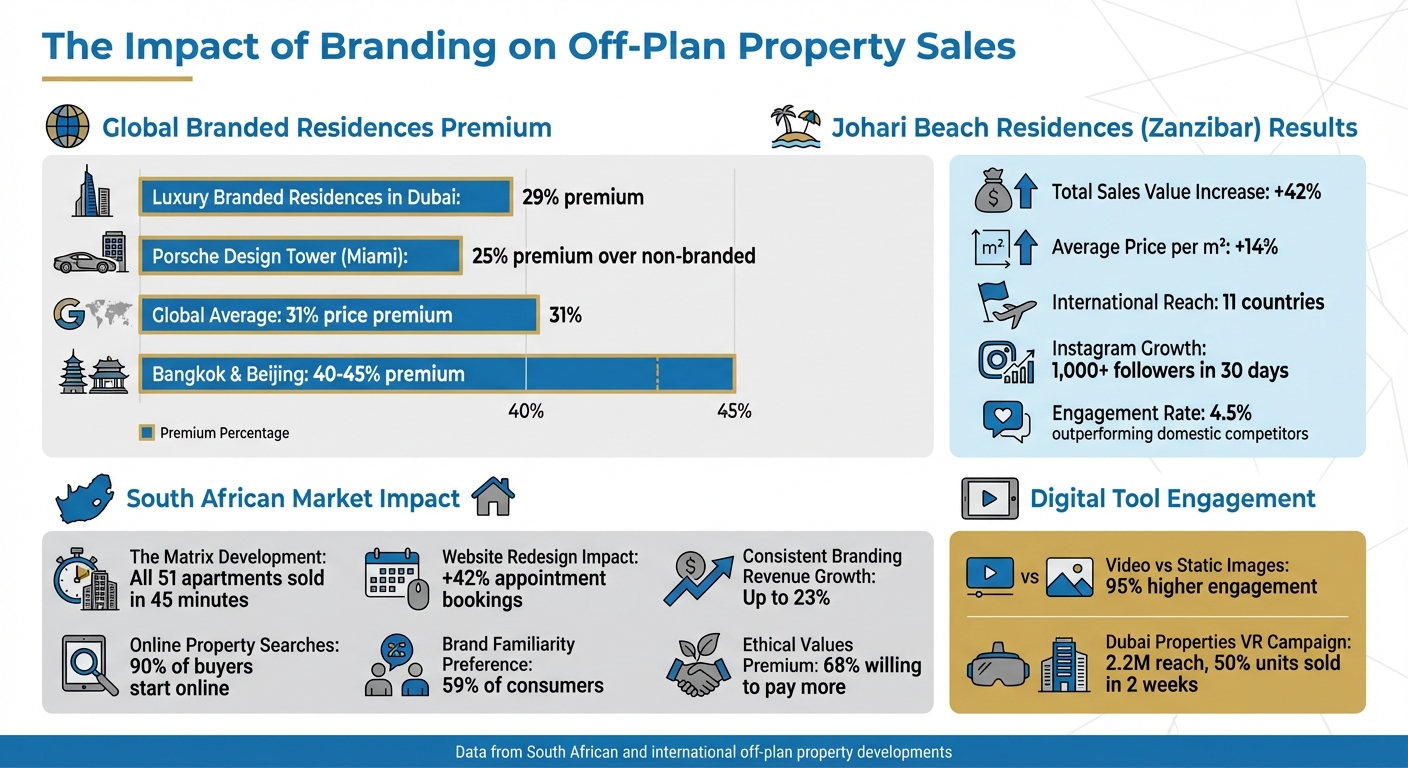
Off-Plan Property Branding Statistics and ROI Impact
Luxury Branded Residences in Dubai
In Dubai, branded residences command a 29% premium, reflecting the trust and quality they offer to international buyers. This premium isn’t just about prestige; it reassures buyers who may never even visit a sales centre.
Take the Porsche Design Tower in Miami, for example. This project showcases how non-hotelier branding can succeed. With standout features like bespoke car lifts, the property achieved a 25% premium over non-branded options. Here, branding goes beyond logos – it’s about crafting unique lifestyle experiences that justify higher prices. Globally, branded residences deliver an average 31% price premium, with markets like Bangkok and Beijing seeing even higher premiums of 40%–45%.
These global trends inspire regional innovations in branding strategies.
Johari Beach Residences (Zanzibar)
Johari Beach Residences used a digital-first strategy to dominate the market. By focusing on targeted SEO with long-tail keywords like "beachfront villas in East Africa" and "Zanzibar property for sale", the project established itself as the go-to option before competitors could catch up.
This approach paid off, increasing total sales value by 42% and boosting the average price per square metre by 14%. The development also diversified its offerings, adding features like co-working spaces and private plunge pools to attract a broader range of buyers. Strategic PR placements in publications such as Business Insider Africa and Luxuo enhanced international credibility, drawing buyers from 11 different countries. On social media, the project saw rapid growth, gaining over 1,000 Instagram followers within 30 days and achieving a 4.5% engagement rate, outperforming domestic competitors.
These strategies highlight how digital tools can reshape regional markets.
3D-Driven Campaigns in South Africa
South African developers are showing how cutting-edge visualisation can transform off-plan sales. A standout example is the campaign for The Matrix development in Century City, managed by Machete Creative for Rabie Property Group. Incredibly, all 51 apartments were sold within just 45 minutes of launch. The secret? Architecturally precise computer-generated images (CGIs) combined with well-executed pre-launch branding that built trust before construction even started.
"Accurate CGI images are critical to off-plan sales success." – Machete Creative
Across multiple South African projects, CGI-driven campaigns have consistently led to all units being reserved before construction begins. These photorealistic 3D renders, designed to be indistinguishable from real photographs, create the emotional connection that drives buyers to commit. With most property searches starting online, high-quality digital assets are now essential for making a strong first impression. Local services like 3D Rendering Services South Africa offer tools like CGI site plans and immersive VR experiences, tailored to meet the expectations of South African buyers. These tools have proven to be game-changers in achieving rapid sales success.
Practical Advice for South African Developers
Here’s how to tailor your branding strategies to connect effectively with the South African market.
Align Branding with Local Buyer Needs
In South Africa, buyers often focus on security, energy resilience, and lifestyle features. Your branding should highlight these priorities. Showcase elements like advanced security systems, solutions for load-shedding, and communal spaces such as braai areas, gyms, and pools. Katya Varga, Assistant Area and Projects Manager at Pam Golding Properties, emphasises:
"Estate agents selling off-plan must be able to present clear, credible value."
Be upfront about transfer costs, and emphasise your NHBRC registration and proven track record to establish trust and credibility.
Leverage Architectural Visualisation Tools
To bring your project to life for potential buyers, invest in photorealistic CGI visuals. These tools allow buyers to picture the final product, making them an essential part of the sales process. The Matrix development in Century City is a great example of how indispensable these visuals can be. Tailor digital furnishings and finishes to align with specific buyer personas, and consider offering virtual reality (VR) experiences. These can be showcased in a sales office or accessed remotely, providing an immersive view of the development.
Companies like 3D Rendering Services South Africa specialise in tools such as CGI site plans and VR experiences, designed specifically for the South African market. These tools not only help buyers visualise but also build confidence, speeding up the sales process.
Ensure Consistency Across All Branding Channels
Consistent branding is key to building trust and professionalism. Research shows that companies with consistent visual messaging and brand values can experience revenue growth of up to 23%. To achieve this, create a brand book that outlines clear guidelines for logo use, colour schemes, and typography. This ensures alignment across your marketing team and sales agents.
Buyers are naturally drawn to brands they recognise – 59% of consumers prefer brands that feel familiar. Regularly audit your marketing materials to ensure consistency, and start this process at least 3 to 6 months before launching sales. A unified, polished brand presence not only builds trust but also accelerates off-plan sales.
Conclusion
Branding turns technical blueprints into emotional stories, enabling potential buyers to imagine their future homes. By combining a strong visual identity with photorealistic 3D renders and virtual tours, developers can transform basic plans into a lifestyle buyers aspire to.
The numbers back this up. Local data shows branded developments close sales much faster. For instance, one South African developer saw a 42% jump in appointment bookings after updating their website to reflect a luxury feel. Another reported a 37% boost in pre-sales by ensuring their physical signage aligned with their brand values.
The key to success lies in addressing local priorities – like safety, proximity to schools, and lifestyle amenities – while maintaining consistent visuals across all platforms. High-quality architectural visualisation is no longer optional; it’s a critical tool for building trust even before construction begins. These stats highlight how branding, when tailored to local market needs, can make all the difference.
Accurate computer-generated imagery (CGI) plays a pivotal role in off-plan sales, giving developers the credibility they need to win over buyers from the start.
To make the most of these benefits, developers need a clear, proactive branding strategy. Begin your branding efforts as soon as planning approval is secured. This includes investing in photorealistic CGI visuals, creating a brand book, and showcasing your NHBRC registration. Services like 3D Rendering Services South Africa offer locally tailored CGI and VR solutions, turning concepts into powerful sales tools.
With 90% of buyers starting their property search online, having a cohesive and engaging digital brand presence is crucial for South African developers to make a lasting first impression.
FAQs
How does branding help build trust in off-plan property sales?
Branding plays a key role in building trust when it comes to selling off-plan properties. By presenting a polished and consistent image, branding reassures buyers and eases concerns about investing in a property that hasn’t been built yet. Elements like a distinctive logo, a well-thought-out colour palette, and a clear tone of voice signal professionalism and credibility. When these elements are applied consistently across marketing channels – whether it’s a website, brochure, or social media – they create an emotional connection and convey a sense of transparency and dependability.
Visual assets are equally important in this trust-building process. Tools like 3D renders, virtual tours, and detailed floor plans help bring the project to life, turning abstract concepts into something buyers can see and imagine themselves in. These visuals aren’t just about aesthetics; they give buyers confidence that the developer can deliver what’s promised. In South Africa, where property buyers often approach investments cautiously, these tools are especially effective in demonstrating quality and reliability.
Beyond visuals, a strong and consistent brand story adds another layer of trust. By showcasing the developer’s past successes, core values, and clear delivery timelines, the brand positions the development as a safe and worthwhile investment. This kind of narrative not only enhances the developer’s reputation but also justifies higher pricing and speeds up sales. Together, these elements – compelling visuals and authentic storytelling – create a trustworthy and appealing proposition for South African homebuyers.
What are the key digital tools for effective off-plan property marketing?
Successful marketing of off-plan properties hinges on using digital tools that help buyers picture developments long before they’re built. One of the most effective methods? High-quality 3D visualisation. These tools turn architectural blueprints into lifelike renders, fly-through animations, and lifestyle-focused imagery. Such visuals don’t just inform – they spark an emotional connection with potential buyers. Local services like 3D Rendering Services South Africa specialise in creating these visuals, tailored specifically for developers in the region.
For an even deeper connection, virtual reality (VR) walkthroughs and augmented reality (AR) experiences let buyers explore properties without ever stepping foot on-site. Whether accessed remotely or in a sales suite, these tools provide a realistic glimpse of what the finished space will look like. To tie it all together, a dedicated project website acts as a central hub, showcasing renders, VR tours, and floor plans while also collecting leads through integrated forms. Pairing these features with social media campaigns and targeted digital ads helps developers reach the right audience and build a strong presence in South Africa’s competitive property market.
How can property developers adapt their branding to appeal to different buyer groups?
To connect effectively with various buyer groups, developers need to adapt their branding to resonate with the unique preferences and goals of each segment. Begin by identifying key categories of buyers, such as first-time homebuyers, investors, luxury buyers, or downsizers, and then adjust your visual style, messaging, and marketing platforms to suit each group.
For first-time buyers, emphasise affordability and practicality. Use bright, engaging branding, transparent pricing (e.g., R 1,250,000), and visuals that highlight features like access to schools or public transport. Investors, on the other hand, are drawn to data-focused content that highlights ROI, rental yields, and security benefits. Meanwhile, luxury buyers expect elegant branding, refined imagery, and narratives that showcase exclusivity – think golf-course views or private facilities.
No matter the audience, tools like high-quality 3D renders, virtual staging, and VR walkthroughs are crucial to make off-plan developments feel tangible. For South African buyers, ensure localisation by using South African English, displaying prices in R with proper formatting (e.g., R 1,250,000), and referencing metric measurements (e.g., m²). By aligning branding with the priorities of your audience and reflecting local nuances, developers can foster trust and drive off-plan sales.
Related Blog Posts
- How to Market Off-Plan Developments in South Africa with 3D Renders
- How 3D Renders Help Developers in Gauteng, Cape Town & Durban Close Deals Faster
- How to Stand Out in South Africa’s Competitive Property Market with 3D Visualisation
- Virtual Tours + 3D Renders: The Ultimate Combo for Off-Plan Sales

