

When marketing off-plan developments in South Africa, CGIs (computer-generated imagery) are crucial for showcasing properties before construction begins. Done right, they help developers secure early reservations, with some achieving 100% unit reservations before building starts. However, poorly executed CGIs can harm credibility and slow sales.
Here are the 7 most common CGI mistakes and how to avoid them:
- Wrong Scale and Proportions: Misleading dimensions can erode buyer trust.
- Missing Local Details: Generic visuals fail to reflect South Africa’s landscapes, plants, and lighting.
- Unrealistic Interiors: Designs that don’t suit local lifestyles feel disconnected.
- Flat Lighting and Shadows: Poor lighting makes renders look fake.
- Ignoring Lifestyle Expectations: Overlooking features like braai areas weakens appeal.
- Low-Quality Images: Blurry renders reduce professionalism.
- Inconsistent Marketing: CGIs that don’t match other materials confuse buyers.
To fix these issues, use precise architectural data, include local elements, design functional interiors, optimise lighting, and ensure high-quality, cohesive visuals. Professional CGI services in South Africa can cost R4,500 for interiors and R7,700 for exteriors. Investing in accurate, high-resolution renders helps build buyer trust and drive off-plan sales.
7 Arch Viz Beginner Mistakes and how to AVOID Them
sbb-itb-f5a6292
7 Common CGI Mistakes Developers Make
Even seasoned developers can stumble into CGI pitfalls. Here are seven frequent errors and why they matter.
Wrong Scale and Proportions
Mistakes in scale – like oversized walls or tiny furniture – can mislead buyers once they see the actual property.
"In architectural visualisation, requests to cheat in projects over reality are common… Extending walls, removing columns… the list is long" – George Nicola, Expert Stager
These issues often stem from a lack of accurate architectural data. Without precise .dwg files or confirmed site plans, the 3D model may not align with the final construction. Problems with furniture scaling – using virtual pieces that don’t match real-world dimensions – also risk creating unrealistic impressions, like making small rooms appear far larger than they are.
This gap between expectation and reality can erode trust, leaving potential buyers sceptical about the property’s true features.
Next, let’s look at how missing local environmental details can weaken the connection between CGIs and South African buyers.
Missing Local Environmental Details
Generic CGIs often fail to capture the essence of South Africa. Blank landscapes, non-native plants, or lighting that doesn’t reflect the country’s bright climate can make it hard for buyers to imagine living there.
Aerial renders are especially crucial in competitive markets like Johannesburg, where buyers need to understand the property’s proximity to landmarks, roads, and amenities.
"Project marketing architectural visualisation… goes beyond showcasing what a building looks like – it communicates the lifestyle, environment, and value proposition of the project" – PropertyRender.co.za
Your CGI team must work with detailed landscape plans, references for native vegetation, and accurate weather data to create visuals that feel authentic. Without these elements, potential buyers may struggle to connect with the property.
Realistic interiors and lighting are equally important to complement these environmental details.
Unrealistic Interiors That Don’t Work
CGIs with impractical interiors often miss the mark for South African buyers. Designs that don’t reflect how families actually live can quickly feel unrelatable.
Interior layouts should match the needs of your target market, whether it’s young professionals in urban flats or families in spacious suburban homes. Using mood boards and demographic research can help create visuals that resonate. For example, open-plan spaces that facilitate social gatherings or seamless indoor-outdoor areas that suit the local climate can make a big difference.
Without these thoughtful touches, CGIs may look polished but feel disconnected from real-life living.
Flat Lighting and Fake Shadows
Poor lighting can ruin the photorealism of your renders. Shadows that don’t match South Africa’s sun angles or interiors lit with flat, artificial light can make a CGI look fake.
Renders should reflect local conditions, such as the harsh midday sun and the long shadows it casts. Using generic international lighting templates often results in visuals that feel out of place to local buyers.
Professional CGI production usually involves a second round of revisions to fine-tune lighting and shadows. Skipping this step risks producing visuals that fail to highlight the property’s best features.
Ignoring Local Lifestyle and Culture
CGIs that overlook key lifestyle and cultural elements miss the chance to appeal to South African buyers.
"Tell a story with CGI narrative and sell the dream for clients’ lifestyle" – George Nicola
For South Africans, this dream often includes braai areas and inviting outdoor spaces. Incorporating these elements into your renders can create a stronger emotional connection with buyers.
In a market where buyers decide in seconds – attention spans can be under 8 seconds – failing to reflect local lifestyle expectations can cost you a sale.
Low-Quality Images for Marketing
Blurry or pixelated CGIs can make your project seem unprofessional. Whether they appear on billboards, in brochures, or online, low-quality renders can make buyers question the overall quality of the development.
"Using low-cost CGI services… may do more harm than good" – George Nicola
Photorealistic CGIs that closely resemble real photos are essential. High-quality visuals are not just a luxury – they’re an investment in credibility.
"Developers who fail to adopt [high-quality] approach risk falling behind their competitors" – PropertyRender.co.za
When competitors use lifelike CGIs, cutting corners on quality can cost you valuable buyer attention.
CGIs That Don’t Match Other Marketing Materials
Inconsistent visuals across your marketing campaign can confuse buyers. If your CGIs feature one design style while your brochures or website use another, it creates a disjointed experience.
This often happens when developers commission CGIs without a clear scope that integrates with brand guidelines. The result? A collection of mismatched images that fail to work as a cohesive marketing tool.
To avoid this, ensure your CGI production aligns with how and where the visuals will be used, from social media posts to large-format billboards. A unified approach saves resources and strengthens your overall campaign.
Addressing these mistakes is crucial – next, we’ll dive into specific steps to fix them.
How to Fix These CGI Mistakes
Now that you’ve spotted the common errors, here are some actionable steps to ensure your CGIs effectively represent South African property developments.
Use Precise Architectural Data and Models
Your CGI should follow the exact specifications provided by your architect, including details like planned materials, windows, and fixtures. To achieve this, submit complete .dwg (CAD) files and BIM plans before the 3D modelling begins.
"Architectural visualisation refers to the 3D model of a property – whether the interior, exterior or both – which is built to the exact specification of the architect."
High-quality site photos are essential to ensure the CGI blends naturally with the South African setting. Providing detailed CAD/BIM data and environmental information while involving technical experts helps maintain accuracy. A two-stage process – initial modelling followed by revisions – can save time and resources.
"By allowing enough time for the 3D project to be completed professionally, it cost less time, money and hassle."
- George Nicola, Expert Stager, Tallbox
Interior CGI images in South Africa typically cost around R4,500 each, while exterior renders start at approximately R7,700. With accurate data, your visuals can better reflect the local environment.
Incorporate South African Environmental and Lifestyle Details
Beyond architectural precision, adding local environmental elements helps ground your visuals. Replace generic landscapes with drone-captured imagery and textures that mirror the actual location. This is especially important in cities like Johannesburg, where buyers value proximity to landmarks, roads, and amenities.
Use photorealistic textures, local landscaping, and lighting adjustments to reflect South Africa’s seasonal conditions. For gated estates or mixed-use developments, highlight communal spaces, green areas, and parking to showcase the project’s full scope. Avoid generic designs that don’t match the local reality, as they can mislead buyers and damage trust.
The Professional Plan is a great choice for projects requiring advanced visualisation, including native vegetation, lifestyle elements, and high-resolution output that feels true to the location.
Design Functional, Liveable Interiors
Your interiors should resonate with the way South African families live. Use mood boards to finalise finishes, ensuring the design aligns with your target buyers. For example, open-plan layouts for social gatherings or indoor-outdoor spaces suited to the climate can make a big difference.
Virtual staging is a cost-effective way to showcase interiors, especially for unfurnished properties. Designing spaces that reflect "family home" appeal can also help estate agents connect more effectively with potential buyers.
Optimise Lighting and Shadow Quality
Lighting plays a crucial role in creating realistic CGIs. Define lighting parameters early – consider the time of day, weather, and mood you want to convey. South Africa’s unique lighting conditions, such as the intense midday sun and long shadows, should be reflected in your renders.
Mood boards can help ensure lighting interacts realistically with surfaces, while avoiding overly bright or altered spaces that compromise credibility.
"The purpose of the marketing visuals is to showcase the most significant features and achieve the best sales results off-plan."
- George Nicola, Expert Stager, Tallbox
Avoid rushing deadlines, as this can lead to poor lighting and shadow details. The Enterprise Plan even offers VR solutions with dynamic lighting simulations, allowing buyers to experience properties under realistic South African conditions at different times of day.
Produce High-Resolution Renders
Sharp, high-resolution images are critical for professional marketing. Whether used on billboards, brochures, or online platforms, your CGIs must maintain quality across all formats. High-resolution renders should be indistinguishable from real photographs.
"A lifelike CGI is worth a thousand empty rooms."
- Property Studios
Integrate high-resolution CGIs with interactive tools like plot locators to let buyers explore unit details and views. For large-scale South African developments, this approach is particularly effective. Both the Professional Plan and the Enterprise Plan deliver exceptional image quality: the Professional Plan is ideal for standard marketing needs, while the Enterprise Plan offers unlimited revisions to perfect every detail and build buyer confidence.
Align CGIs With Your Brand and Marketing Strategy
Your CGIs should fit seamlessly into your overall marketing plan. Decide early on where and how the visuals will be used – whether on social media, billboards, or print – to ensure a consistent brand experience. Match your CGIs to your brand guidelines, target audience, and market analysis. For mixed-use precincts or gated estates, the visuals should clearly communicate the lifestyle, setting, and unique features of the project.
"A well-executed project marketing render is more than an image – it is a strategic marketing tool that drives interest, accelerates sales, and enhances project credibility."
- PropertyRender.co.za
The Enterprise Plan offers comprehensive property marketing solutions, including branding, web development, and strategic support to ensure your CGIs contribute to a cohesive and effective campaign.
Mistakes vs Solutions: Quick Reference
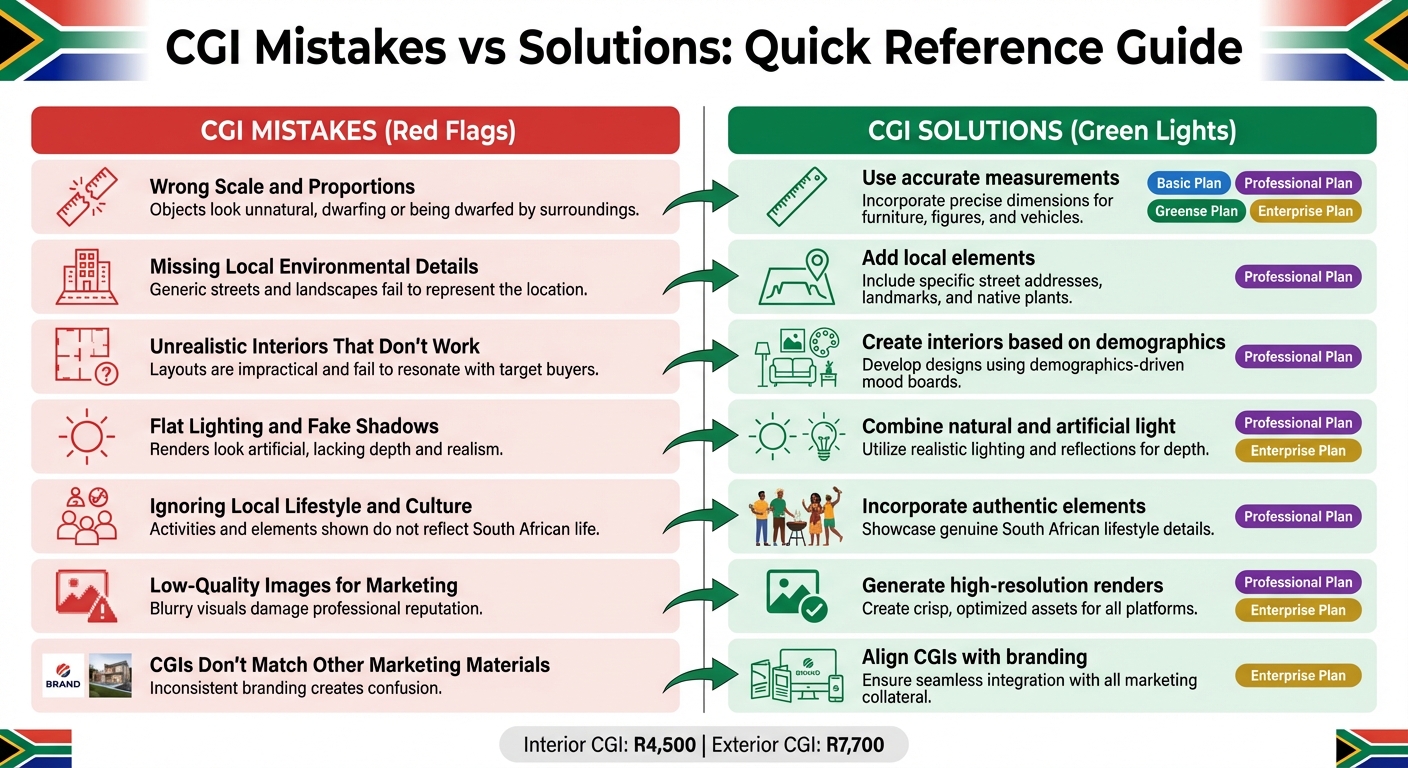
7 Common CGI Mistakes vs Solutions for South African Property Developers
Comparison Table
Here’s a handy table that summarises common CGI mistakes, their fixes, and the recommended plans to address them:
| CGI Mistake | Solution | Relevant Plan |
|---|---|---|
| Wrong Scale and Proportions | Use accurate measurements to ensure furniture, figures, and vehicles are properly scaled | Basic Plan / Professional Plan |
| Missing Local Environmental Details | Add local elements like street addresses, landmarks, and native plants | Professional Plan |
| Unrealistic Interiors That Don’t Work | Create interiors based on demographics-driven mood boards tailored to buyers | Professional Plan |
| Flat Lighting and Fake Shadows | Combine natural and artificial light for realistic reflections and shadows | Professional Plan / Enterprise Plan |
| Ignoring Local Lifestyle and Culture | Incorporate authentic South African lifestyle elements | Professional Plan |
| Low-Quality Images for Marketing | Generate high-resolution renders with optimised assets | Professional Plan / Enterprise Plan |
| CGIs That Don’t Match Other Marketing Materials | Align CGIs with your branding for a seamless marketing approach | Enterprise Plan |
This quick reference ensures your visuals not only meet professional standards but also resonate with local preferences, enhancing your marketing impact.
- Basic Plan: Ideal for essential rendering tasks, offering limited revisions.
- Professional Plan: Perfect for advanced visualisation needs, including VR tools and moderate revisions.
- Enterprise Plan: Designed for large-scale developments, this plan includes unlimited revisions, branding integration, and strategic marketing support.
Select the plan that aligns with the scale and complexity of your project to achieve the best results.
Conclusion
Avoiding CGI missteps is crucial for successful property marketing in South Africa. Crafting effective CGIs demands technical expertise and a deep understanding of local architectural trends, buyer preferences, and regional details. The seven mistakes discussed in this article – ranging from inaccurate proportions to poor-quality images – can seriously undermine your marketing efforts and erode buyer trust.
Fortunately, each of these pitfalls has a clear fix. By leveraging precise architectural data, incorporating South African-specific details, designing interiors tailored to your target audience, and producing high-resolution renders, you can create visuals that truly resonate with potential buyers. Most importantly, photorealistic renders help buyers clearly understand what they are investing in, which is key to building trust and driving sales.
3D Rendering Services South Africa addresses these challenges with tailored solutions across three service tiers. Whether you need straightforward rendering or all-encompassing marketing support with unlimited revisions, there’s a plan to ensure your visuals meet professional standards while aligning with local market expectations.
Investing in professional CGIs isn’t just about showcasing properties – it’s about selling a lifestyle, building buyer confidence, and driving off-plan sales effectively.
FAQs
What files should I give my CGI team to keep scale accurate?
To achieve precise scaling, it’s important to provide detailed architectural drawings and CAD files. These should include floor plans, elevations, sections, and site plans in formats like PDF, DWG, or SketchUp. If you have them, sharing 3D models in formats such as Revit, SketchUp, 3Ds Max, Rhino, or FBX can be incredibly useful. Including reference images and material specifications will also help ensure accurate visual and spatial representation.
How do I make CGIs look authentically South African?
To craft CGIs that genuinely reflect South Africa, focus on integrating elements that showcase local charm and practicality. Use architectural styles and landscapes that are distinctly South African, incorporating details like indigenous plants and natural surroundings. Features that matter to South African buyers – such as security measures, solar energy, energy-saving designs, and lifestyle-focused amenities – should take centre stage.
Adding iconic visuals, like the sweeping views of Table Mountain or the country’s stunning coastlines, can make the imagery instantly relatable. These touches not only capture regional beauty but also align with the preferences and aspirations of local audiences.
How many CGI revisions should I plan for before launch?
Planning for 2 to 3 CGI revisions before launch is a smart move. This process ensures the visuals align with both quality standards and client expectations. By refining the details, you can create precise and engaging representations of your property that truly stand out.
Related Blog Posts

